East Asia is coming to the fore in economics, politics and culture. In the West, too, there is a new awareness of “the East.” Western scholars now argue that there are fundamental differences between the civilizations and philosophical thought of East and West, and that these differences have run on for thousands of years.
Psychologists have argued for universality, a concept that embraces all of humanity, but many scholars have recently offered a new view: that the West (Europe and the United States, including Australia, Canada and New Zealand) and East Asia (including China, Korea and Japan) have for thousands of years kept to very different systems of thought.3
They find that East Asia formed a civilization distinct from the West as long as 2,500 years ago, and that, counted by civilization, the East has about twice the population of the West.
More than a billion people in the world follow the system of thought of ancient Greece, while more than two billion have traditionally inherited the system of thought of ancient China. Both the Greek and the Chinese systems of thought were founded on philosophical analysis and system some 2,500 years ago. The two civilizations have very different philosophies, and differ too in their social structures and in the way they see themselves.4
East Asia matters to the world’s system of civilizations. By around the third century BC, West and East had already formed very different cultures. Wells presents a map of “The world known to us in 250 BC” with an account of it.5 At that time Eurasia and the north of Africa were the whole of the world known to humankind, and as civilizations it was divided into East and West.
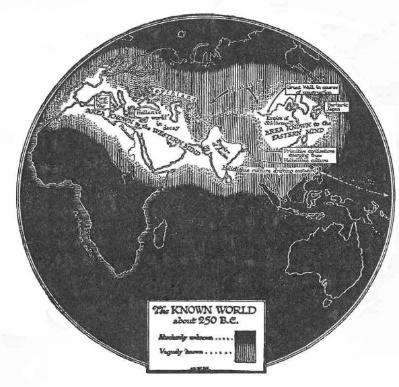
The world known to Westerners took in Europe, North Africa, the Middle East and India. The world known to Easterners took in China, Korea and Japan.6 These two civilizations grew up independently, each on its own, without cultural ties between them. How do they differ?
Human beings are the only animals with a mind. Because of the mind, we come to ask who we are. Where do we come from, and where are we going? To answer these questions, human beings began to search for absolute truth. The East found absolute truth in “the Dao (道) of nature.” The West found it in a “transcendent God (神).” The Dao and God are the only two absolute truths there are in the world, standing for nature and for the supernatural. The concept that most fundamentally divides East from West is therefore the Dao of the East and God of the West, which grew into the natural philosophy of the East and the revealed religion of the West.
The two absolute truths, the Dao and God, are set out in the Daodejing and in the Torah (the Five Books of Moses of the Old Testament) respectively. Both look to the same two things as the origin of nature and the cosmos: nothing (無) and being (有). In cosmological terms, the question is which of the two, space or the heavenly bodies, makes up the cosmos. According to the Daodejing and the Torah, the Dao takes nothing as the origin of the cosmos, and God takes being. Once the origin is settled, the central questions follow from it: what the principles of nature and the cosmos are. If one pictures a cosmos in which space and the heavenly bodies turn into each other and change, a “philosophy of change” between nothing and being becomes the principle of the cosmos, as it did in the East. If one pictures only the heavenly bodies as having real existence, a “philosophy of being,” in which only being exists, becomes the principle of the cosmos, as it did in the West.
The origin and principles that human beings assign to the cosmos lead naturally to the origin and principles of the human affairs in which they act. In the East the origin of human affairs is wuwei (無爲), non-action, centered on nothing; in the West it is youwei (有爲), purposeful action, centered on being. Wuwei is explained in the Daodejing as the source of the Dao’s action; youwei is expressed in the revealed religions as the law of God. The Eastern principle of the cosmos, the philosophy of change, becomes in Eastern human affairs the ever-changing “thought of yin and yang”; the Western origin of the cosmos, the philosophy of being, becomes in Western human affairs the unchanging “thought of good and evil.” These questions of the cosmos and of human affairs are the core of the two civilizations, and at the center, as their axis, stand the Dao of the East and God of the West.