1) The Relationalism of the East vs the Individualism of the West
In the West, the philosophy of “individualism” is a concept at the core of civilisation. Individualism is strong in opposition and independence. As the opposite of individualism, Western civilisation uses “totalitarianism” or “collectivism,” and sometimes “communitarianism.” These are all Western terms, analysed from the centre of individualism within the Western philosophical system. Totalitarianism and collectivism are used as the opposite of individualism in the sense of not recognising individual freedom; fascist and communist regimes are totalitarian. Communitarianism is used in the sense of giving up individual independence for the sake of the whole, for the sake of harmony; the Spartan way of running things is communitarianism. All of these belong to collectivism.
Collectivism is a philosophy that sacrifices the individual for the group. Historically, collectivism has shown a drift towards pursuing the interests of those who rule the group alone. Nazi Germany and Soviet communism offer historical proof, and Orwell’s novel Animal Farm depicts it starkly. Mindful of this history, Western thinkers, weighing the problems of individualism, have put forward a new social philosophy: communitarianism. Individualism is the philosophy that the rights and freedom of the individual matter most in human society; communitarianism is the philosophy that common interests or purposes matter most. The problem is that once one begins to argue for communitarianism, the common interest becomes important and the individual’s interest less so. Collectivism, as revealed historically in the practice of communism, carries the meaning of destroying individualism. For example, the ten measures Karl Marx put forward in the Communist Manifesto are all principles of a collectivism that destroys individualism: a Spartan small-scale communitarianism expanded to a whole state and to the world.
Western-style collectivist thought is hard to find in the history of Eastern civilisation. The philosophical systems of Daoism, Confucianism and Buddhism, which represent Eastern civilisation, all oppose collectivism and argue for “relationalism.” Westerners especially tend to lump together everything that is not individualism as collectivism, because the concept of relationalism does not exist in Western civilisation. That in Eastern civilisation the opposite of Western individualism is relationalism is something one notices only when one can step outside the frame of Western civilisation to compare the civilisations of East and West.
Without understanding that the core of Eastern relationalism is the philosophical opposite of the core of Western individualism, it is hard to understand Eastern thought. Regrettably, most Western thinkers still understand the opposite of individualism to be collectivism, and still teach and write so in schools and the press. This is why the West can understand East and West only if it breaks free of Hegelianism.
Eastern relationalism means protecting my own interest through consideration for the other. Relationalism is strong in complementarity and harmony. Its core is to consider myself and others together. What matters is that, unlike Western communitarianism, relationalism does not give up the independence of the individual. Ren (仁), the ethic Confucianism put forward, has nothing to do with totalitarianism or collectivism. Ren means a relationalism that thinks of others while protecting myself. It refers not to “me” as an “individual” but to the human-to-human “relationship” of “us,” considering myself and others together.
Western vocabulary does have the word relationalism. But in the West it is used mainly as a scientific rather than a humanistic term: the concept of relationalism is used chiefly in quantum physics. Western physics has used it for nearly a hundred years, but it has not yet found a place as a Western philosophical concept, just as Heisenberg’s uncertainty principle and Bohr’s principle of complementarity are expressed only in quantum mechanics and not yet in Western philosophy. Yet the relationalism Western physics seeks to express is very like the relationalism used in Eastern philosophy. In Eastern civilisation, uncertainty and complementarity are already widely used within relationalism, the core concept of Eastern thought. One example is Niels Bohr, who valued relationalism and used the Taiji diagram, symbol of Daoist yin and yang, as it is in his family coat of arms.
This is like the way the concept of complementarity, which replaced opposition in modern Western physics, has taken hold scientifically but is still only slowly seeping into the humanities. Eastern relationalism is a concept not used in connection with human affairs in the Western philosophical system, which centres on individualism. We must therefore take it that Western languages have no philosophical concept expressing relationalism, the core of Eastern human affairs, because everything is embraced by the concept of individualism. In the West what matters is individualism, meaning that I matter, and the relationship to the religious beliefs, philosophical truths and ideological verities I am tied to.
Eastern relationalism and Western individualism are ways of understanding society and the individual from different philosophical standpoints. Western individualism is a philosophy that puts the autonomy and freedom of the individual first. It is strong in opposition and independence. It holds that individuals must be able to pursue their own interests and make free decisions. This concept can be seen as arising from the historical, economic and political background of Western society. Eastern relationalism, on the other hand, sees the individual as a separate being but at the same time as a member of the group to which he or she belongs.
Relationalism does not mean seeing the individual’s rights or interests as subordinate appendages of the whole. It is rather a thought, grounded in yin and yang, of managing the rights or interests of all, myself and others together, along with my own interest. An individual’s actions must take into account their effect on the group to which he or she belongs; conversely, a group’s actions must take into account their effect on the individual. This means valuing interdependence in human relationships and seeking to solve problems in a yin-yang way, from both individual and collective standpoints. It is strong in complementarity and harmony. This concept can be seen as arising from yin and yang, the core of Eastern culture and philosophy.118 Individualism and relationalism therefore show that, according to philosophical premises arising from different cultural backgrounds, they understand the relationship between individual and group differently.
Individualism is absolutely influenced by the revealed religion of the West. The West developed a civilisation with God as its axis. God and I are connected personally and directly. For the individual who believes in God, the relationship between God and me, which transcends every other connection in human affairs, matters most. The God-centred worldview that runs from ancient Greece and Rome into Christian civilisation aims at “individualism.” It understood humanity and the world within God’s creation and providence, and built a civilisation of God through religious and rational inquiry. Western civilisation therefore developed around the faith I hold, absolute truth and a transcendent being.
Against Western individualism, the East has formed a culture whose thought is relationalism. Relationalism spreads through Confucianism, Daoism and Buddhism and permeates Eastern culture deeply and widely.119 The West concentrates the fate of society on laws and institutions that advance individualism. In Western society “ethics” is treated as little more than the etiquette to be observed in each field of society. The consideration for “ethics” that Eastern civilisation treats as more important than law is not treated as important in Western civilisation.
In the East there is a culture that makes ethics such as wuwei, diligence, thrift and freedom from desire take a central place in the human heart. These are all ethics that come from the philosophical system of relationalism. The Eastern work ethic comes from the management of self-interest. In social life people must pursue diligence and thrift through education and self-cultivation, and must acquire compassion and modesty as a guard against self-interest growing into greed.
Relationalism and individualism show in the cosmologies of East and West. Human thought about the cosmos is used to dualities. We express nature and human affairs in two concepts, a duality (二元):120 the sunny side and the shady side, man and woman, sun and moon, summer and winter, left and right, up and down, front and back, past and future, mind and instinct. The Eastern philosophy of change gives these dual elements a “complementarity” centred on relationship. The Western philosophy of being gives each dual element its own “opposition.” In their ways of analysing duality, complementarity or opposition, following the systems of the Dao and God, the difference between East and West is clear. The Eastern philosophy of change and complementarity and the Western philosophy of being and opposition work as the principles that divide the two civilisations in human affairs.
Bring philosophical or moral standpoints into complementary dualism and oppositional dualism, and the civilisations of East and West are distinguished as “the complementarity of yin and yang” and the Western “opposition of good and evil.” The two principles often clash, but human beings need both. The philosophy of change is suited to understanding dynamic systems and explains ethics, the movement of the cosmos and modern physics. The philosophy of being is suited to understanding static systems and explains legal systems, mathematical laws and classical physics.
This difference is very aptly captured by seeing Eastern civilisation as a civilisation of “yin” and Western civilisation as a civilisation of “yang.” But we are not used to using these Eastern concepts. Using Western concepts, the civilisation of yin can be described as the complementarity of yin and yang, and the civilisation of yang as the opposition of good and evil. The thought of yin and yang approaches every relationship in people or in matter through the concept of complementarity or harmony; the thought of good and evil approaches every such relationship through the concept of opposition or independence.
Eastern civilisation shows receptive, autonomous and indirect; relative, relational and tolerant; and inward-looking, defensive and inclusive traits. Western civilisation shows active, interventionist and assertive; absolute, individual and dynamic; and outward-looking, exclusive and enterprising traits.
The Receptive, Autonomous, Indirect East vs the Active, Interventionist, Assertive West
The receptive, autonomous and indirect character of the East and the active, interventionist and assertive character of the West show clearly in the golden rules of East and West. Confucius’s teaching is receptive: “Do not do to others what you would not want done to yourself” (Analects, chapter 12, “Yan Yuan”). Jesus’s teaching is active: “Whatever you desire for men to do to you, you shall also do to them” (Matthew, chapter 7).121 East and West also show contrasting traits in the results that come from their attitude towards others. The West, as in the Bible, teaches an active, activist life, like “the light and salt of the world.” The East, on the other hand, as in the Daodejing, where “clay is made into a vessel and windows and doors into a room, but what is actually useful is the empty space,” warns against an activist life and recommends a receptive one. Eastern thought recommends the soft, yielding nature of water. The Daodejing, too, stresses the virtues of water again and again, because it holds that water is in the end the most effective at overcoming what is hard and strong.
This receptiveness and indirection of the East, and activeness and assertiveness of the West, show clearly in daily life as well. The East values the ability to listen well. When parents teach their children, the first lesson is always to listen well to teachers and to others. The West, on the other hand, values the ability to speak well. So the East shows wariness of speaking well. The Analects teaches: “Clever words and a pleasing manner are far from ren (仁).” “Firm, enduring, simple and slow of speech: this is close to ren (仁).” The Daodejing teaches: “Sincere words are not polished, and polished words are not sincere. The good do not quarrel with others, and those who quarrel are not good. Those who know are not the learned, and the learned do not know.” In the same vein the Daodejing advises: “Yield and overcome; bend and stand straight; empty yourself and be full; wear out and be renewed; have little and be filled; possess much and confusion comes.”
The East shows an indirect tendency set against the assertive tendency of the West. In the East, which pursues wuwei rather than youwei, the recommended way of acting is not to seek immediate effect, as in the West, but to wait for the right moment. Indirect means not taking action at once but watching the movement of shi (勢) and waiting for the moment: a way of acting in which one acts in advance, when the shoots appear, and waits for the foreseen result, rather than acting too late in the future. It is the preference for the way of acting called wei wuwei (爲無爲).
The Daodejing and the Bible both teach humility and yielding. Among the teachings of the Sermon on the Mount is “Blessed are the poor in spirit, for theirs is the Kingdom of Heaven,” which counsels humility and modesty and comforts the persecuted. Likewise the Daodejing teaches: “Bear disgrace with dignity; do not cling to gain and loss; misfortune comes to every human being… Accept all things humbly, and you will be able to preside over all things.” But the West teaches not only modesty and yielding but an active activism as well. The Bible teaches active expansion through the parables of the seed that yields a hundredfold (Matthew 13:8) and of the leaven that leavens all of three measures of meal (Matthew 13:33). This activism is not in the Daodejing, which concentrates on cultivating autonomy and self-restraint.
The Daodejing and the Bible both warn against material wealth. The Daodejing raises the alarm that material wealth can destroy human character. The Bible, too, warns that “it is easier for a camel to go through a needle’s eye than for a rich man to enter into the Kingdom of Heaven.” But along with this it also calls for an active activism about material wealth, in the words “Don’t lay up treasures for yourselves on the earth, but lay up for yourselves treasures in heaven.” Neither the Daodejing nor Confucianism has any passage calling for an activism of amassing wealth to do good. Managing wealth (理財) is treated at the level of ethics: not the individual amassing wealth but “governing wealth to put the people at ease.”
The Relative, Relational, Tolerant East vs the Absolute, Individual, Dynamic West
Eastern civilisation, following the philosophical system of the unmanifest, stresses relativity and harmony. In the Analects Confucius puts forward a relative and tolerant view: “If you attack those who think differently as heretics, it comes back as harm.” The West, following the manifest, puts forward firm doctrine and the thought of good and evil and has them enforced in human affairs: “Be a light that shines on the world.” Stressing this, the West asserts the “inerrancy” of Bible and church, that they cannot be wrong, and shows an absolute and exclusive character.
In the end, in Western civilisation, religious sects multiply, each claiming absoluteness and inerrancy, and struggles over doctrine become unavoidable. In the sixteenth and seventeenth centuries Europe entered wars between Catholics and Protestants, and in the end fought the Thirty Years’ War, counted among the cruelest of wars. At about the same time in the East, the Kangxi Emperor of the Qing issued the Edict of Toleration (容教令) in 1692, allowing Christianity to be preached. Western Enlightenment thinkers regarded the Kangxi edict, which declared freedom of religion, as a remarkably generous measure.
The Kangxi edict was no exception in Eastern history; rather, it followed the traditional philosophy of using the useful teachings of all religions, Confucianism, Buddhism, Daoism and others, in running the state. This shows clearly in the philosophical attitude Eastern civilisation displays: syncretism. There are terms such as fusion, mixture or eclecticism, but in the sense of including the strengths of each, syncretism is the most fitting. Syncretism differs from the manifest, which stakes everything on one conclusion and follows that truth. This character of syncretism appears in Daoism’s attitude of stressing restraint, in the Daodejing’s teaching: “The sage avoids excess, extremes and extravagance.”
This syncretic attitude of the East appears in the West only after the Puritans, who founded America in the New World to escape religious persecution. At last, in the eighteenth century, the First Amendment to the US Constitution provided for freedom of religion, forbidding the establishment of a state religion and guaranteeing free belief and religious practice. The Roman Empire had made Christianity its state religion in the fourth century. Fourteen hundred years later, freedom of religion, an “edict of toleration,” was finally granted in the West.
The cultural difference that stresses the “relational East vs the individual West” shows clearly in daily life too. In the East, when one writes an address, one writes the country, then the city, then the district. When one writes a name, one writes the family name first, which stands for the family, and one’s own given name last. The idea is to find oneself relationally within the whole. The individual exists within relationships. Ren (仁), the ethic Confucianism put forward, is a compound of person and two (人+二), meaning two people. Finding oneself in the relationship between two people means, in the end, compassion: understanding the other’s situation. This is precisely the core of Eastern “relationalism.”
The systems of thought of relationalism and individualism are reflected deeply and widely in the civilisations of East and West. In the West, when one writes an address, one writes the district, then the city, then the country. When one writes a name, one writes one’s own given name first and the family name, which stands for the family, afterward. The existence of the individual is valued above the fused whole. Relationship gives way to the individual. This is precisely the core of Western “individualism.”
In the West what is valued is that the individual exists independently and pursues his or her own interest and freedom, and legal and social institutions are made to guarantee individual freedom and independence. In the East, on the other hand, the individual exists as a relationship between the whole and the individual, and takes into account the effect of his or her actions on the whole. This leads to valuing not only the individual’s character but also the individual’s belonging and mutual relationships. Following yin and yang, it pursues an ethics in which both the whole and the individual matter. In the East exchanging business cards matters, and stating one’s affiliation, along with showing one’s character, helps one grasp one’s place in the whole situation.
This cultural character shows in how time is seen, too. In the East, time is grasped in the order year, month, day, taking the whole context and situation into account. The contemplative tendency is strong. The idea is that when a problem arises, one should respond appropriately by considering the whole situation and the course of events, not by acting at once. This is connected with the Daoist thought of wuwei (無爲): grasp the whole flow, and within its bounds do what is to be done now. In the West, on the other hand, immediate action and instant decisions are valued. For this, one first grasps the day, then the month and year, weighing the meaning of that day and its effect on the whole situation. This Western character rests on the thought that, as against the wuwei of the East, the immediate action of Western youwei (有爲) matters.
The Inward, Defensive, Inclusive East vs the Outward, Exclusive, Enterprising West
The contrast between the inward character of Eastern civilisation and the outward character of Western civilisation shows even in everyday, unconscious actions. In the East, when counting, one counts from one to ten by folding the fingers inward from an open hand. In the West, one counts from one to ten by extending the fingers one at a time from a clenched fist. In the East, when beckoning someone far away to come closer, one waves the hand downward; in the West, upward. And when taking soup with a spoon, in the East one moves the spoon from the far side towards oneself; in the West, from oneself towards the far side.
This inwardness of the East and outwardness of the West are expressed in history as centripetal and centrifugal force. In the West, peoples and nations grew in an outer environment that was always open and expanding. Western civilisation starting from the Aegean in the eastern Mediterranean and advancing into the Mediterranean, the North Sea, the Atlantic and the Pacific, conquering and expanding again and again, shows this. Likewise, all the empires of the West grew and perished through outward expansion. In the East, on the other hand, and especially in China, population growth and territorial expansion often came about through a centripetal force that drew outside powers and peoples into China. The Mongol Yuan and the Manchu Qing are good examples. This difference plays an important role in the history and culture of East and West, and carries on into inwardness and outwardness appearing habitually in the minutiae of daily life.
In the East a receptive attitude is stressed as central. The Daodejing says: “Knowing others is wisdom; knowing oneself is clarity.” Wang Yangming’s philosophy, too, stresses that “it is easy to defeat the bandits in the mountains, but hard to defeat the bandits in the heart.” In the East, when difficulties or problems arise, one first looks at oneself and tries to find the cause within. In the West, one tries first to find the cause outside. In the West, because human beings were created in God’s image, the problem is thought to lie with other people or other countries. In the East, because human beings are all the same regardless of religion or ideology, one thinks that when there is a problem, the most effective solution is to see whether one can remove the cause of it oneself, and to do so.
This contrast between the inward and defensive East and the outward and enterprising West shows in sport as well. The traditional sports of the East, as in taekwondo, judo and kung fu, aim at self-defence, self-control and self-mastery. In the West, from the gladiatorial combats of Greece and Rome to modern boxing and fencing, the aim is victory, overpowering the opponent through enterprising attack.
When the First World War broke out in 1914, most Europeans rejoiced and celebrated. The people of Britain and Germany poured into the squares to welcome the declarations of war. Each was sure its country would win within months. None imagined fighting a war for years without victory.122 In the East, war, especially imperialist war, is seen as the result of greed. War is seen as something done unavoidably, when peace cannot be kept. Naturally, in the East the end of a war is commemorated rather than its outbreak.
2) Science and Philosophy: Classical Physics and Western Thought vs Modern Physics and Eastern Thought
How is the philosophical thought of East and West expressed in science? How are science and philosophy related? Physics is divided into classical physics and modern physics. Modern physics is the physics that follows the system of thought newly discovered in the quantum mechanics of the twentieth century. It is built on a system of thought entirely different from that of classical physics. Classical physics follows causality. Modern physics rests on probability. Causality and probability go beyond mere concepts of physics: they explain the nature of the universe. Causality makes up the philosophy of being, opposition and absoluteness that form the foundation of Western philosophy. Probability, on the other hand, makes up the philosophy of change, complementarity and indeterminacy that form the foundation of Eastern philosophy.
Causality, represented by Newton’s physics, holds that the state of the universe can be described perfectly in mathematical terms. Between cause and effect there is no room for any chance to slip in. If one knows the present state exactly, one can predict every future event perfectly. Classical physics of this kind saw chance and probability as stemming from human ignorance or lack of information, and held the laws of nature to be wholly causal. In classical physics probability was not a law of physics but merely a statistical tool. It is a position that ignores or denies probability.
Probability, which quantum mechanics holds important, accepts as natural phenomena the phenomena of change that occur by chance, one after another, without any causal connection. Change, that is, “flow,” is the natural phenomenon. Probability rests on a worldview that accepts uncertainty and contingency. It is a worldview that values not necessity but tendency, the flow of shi (勢). Causality upholds a worldview of 100 percent determinism, while probability upholds a worldview in which outcomes appear with a probability of 70 or 80 percent. The scientific thinking of probability and causality derives from the cosmologies of East and West: the Eastern philosophy of change yields probability, and the Western philosophy of being yields causality. If the philosophy of being pursues “what,” the philosophy of change pursues “how things are becoming.”
Modern physics denies the causality, opposition and absoluteness that classical physics maintained. In place of classical physics, which rests on causality, the philosophy of being, opposition and absoluteness, probability, the philosophy of change, complementarity and indeterminacy emerge as the new core concepts of modern physics. These scientific discoveries of twentieth-century Western modern physics agree exactly with probability, the philosophy of change, complementarity and indeterminacy, the ways of thinking that Eastern philosophy has held to be its core.123
The philosophy of change and the philosophy of being, as accounts of the universe, are precisely the core concepts of the Dao of the East and the God of the West. In Eastern philosophy the universe is not a fixed substance but yi (易), the very process of ceaseless change. In Western philosophy the universe is expressed as being, a fixed substance. Western causality seeks an unchanging law: “A always leads to B.” But the philosophy of change upheld by the Eastern thought of yi holds that countless variables (time, place, the movement of shi, human action) intervene in the process by which A produces the result B, so that the outcome appears not as necessary but as a probable, plausible pattern. In a world where change, as the Yijing holds, is the default, the best humans can do is not perfect causal prediction but to read change, respond to it and so gauge the future. Interpreting the hexagrams of the Zhouyi is not a prophecy that things will certainly turn out so. “Prophecy” is what the oracle seeks. The Zhouyi means to offer “advice”: such and such a change is always in motion now, so on that basis such and such is highly probable in the future. That is why Eastern thought focuses not on attributes grounded in the existence of individual elements but on watching change as a whole, examining a changeability founded on flexible probability rather than on fixed causal answers. Probability, the core of Eastern thought, rests not on disorder but on the vast change of the universe.
The Western philosophy of Being rests on the ontology of Parmenides, that “being does not change,” and on being as creation, contained in the philosophy of God. The world seems to change chaotically, but behind it, so this view holds, there is being (God), an eternal and unchanging substance. This philosophy of Parmenides passed through Plato’s Ideas to medieval theology and the metaphysics of Descartes in the early modern period, and took its place as the core of Western thought. The philosophy of change, of Becoming, on the other hand, upholds the worldview that “everything flows.” Change is the core of the Eastern thought of yi (易), and the philosophy of the Western Heraclitus. As Heraclitus saw, “we cannot step into the same river twice.”
Causality and Western Geometry vs Probability and Eastern Algebra
Surveyed from a broad perspective, the systems of thought of ancient science converge in the end on two great sources: “the geometry of form and logic” and “the algebra of quantity and relation.” These amount to more than branches of mathematics: they come down to the two fundamental cognitive paths humanity chose in order to grasp the order of the universe. Through geometry the West pursued the source of a spatial philosophy of being. Ancient geometry tried to grasp the world as a perfect structure set in static space. The unchanging Ideas upheld by Plato and others are its philosophical expression: the belief that visible things may change, but the geometric principles behind them, such as the Pythagorean theorem, are eternal. This became the foundation of the philosophy of being at the core of Western civilisation. It sought to establish, through law and proof, universal truths that no one could refuse, and this gave birth to Western rationalism and causality. It became the foundation of modern science, which interpreted astronomy as the geometric motion of the celestial spheres and understood the physical world as a geometric arrangement of particles.
Through algebra the East set out on the path of a temporal relationalism. Ancient algebra was an attempt to grasp the world as “the interaction among changing quantities.” In this way the East pursued a dynamic philosophy of change. An algebraic equation is not a fixed form but a process of finding an unknown value by balancing the left side against the right. This connects with the “philosophy of change” that reads the changes of the world. The philosophy of change valued, over static proof, the procedure and shu (術) for working a problem through: the algorithm. It fostered a probabilistic way of thinking that accepts contexts that change with circumstances. Algebra, which calculated the passage of the solar terms (time), distributed social resources (taxes, land) and grasped the organic shi (勢) of all things, became the source of Eastern science.
In modern physics, Einstein’s theory of relativity explains the causality of the universe through “geometry,” and quantum mechanics explains the probabilistic character of the microscopic world through “algebra.” From the standpoint of cognitive anthropology, the human brain has developed side by side a capacity to perceive the world as shapes and a capacity to perceive it as order and relation. That ancient science converges on geometry and algebra means, in the end, that these two frameworks were the two best tools of abstraction that the structure of human cognition could draw on to understand the universe.124 The scheme of Western geometry = causality = the philosophy of being, and Eastern algebra = probability = the philosophy of change, is a way of understanding the character of the civilisations of East and West. If Western geometry sought to “define” the essence of being and set up an unchanging Law, Eastern algebra sought to “manage” the context of change and find a fluid Dao (Way).
The philosophy of being, together with causality, leads to opposition. The philosophy of change, together with probability, leads to complementarity. Causality rejects leaps. So the West came to take the idea that “nature does not leap” as the truth of natural phenomena and of science. Not leaping leads in the end to asserting opposition between beings. From it the West drew the maxim “the war of all against all” and made it one of the centres of early modern Western philosophical thought. The Eastern philosophy of change, on the other hand, together with probability, upholds complementarity. Individual things that are not fixed but changing complement one another and form a single whole. This appears in the syncretism of all doctrines and the yin-yang complementarity that Eastern philosophical thought upholds.
Western science, and classical physics above all, was built on the philosophical system of causality from Greek and Roman times through the Middle Ages and the whole of the modern period. Euclid’s geometry, with its rigorous causal logic, came to form the basis of classical physics, which made up Newton’s mechanics. In building his classical physics, Newton drew inspiration from the causality of Euclidean geometry. The East, by contrast, concentrated on algebra instead of geometry. Western geometry, upholding causality and deductive necessity, made deterministic thinking the axis of its civilisation. Eastern algebra, upholding probability and dynamic relationality, made indeterminate thinking the axis of its civilisation. Algebra attends not to static geometric figures but to changing numbers (數) and to shu (術), the process of calculating them.
Western science began with geometry, which played a central role in navigation around the Mediterranean. Western civilisation came to follow the causality of geometry, on which life and death at sea depended. Eastern algebra concentrated on an inductive and practical approach to solving the problems of daily life at the heart of the nation-state: land surveying, tax calculation, astronomical observation and the like. It connects with a probabilistic way of thinking that values, more than fixed truth, the correlation and harmony among quantities that change with circumstances.
The Eastern classic of algebra comparable to Euclid’s Elements in the West is the Nine Chapters on the Mathematical Art (九章算術). The book was completed around the turn of the era, in the Han dynasty, by gathering the knowledge of many scholars. Later, not only in China but also in Korea, Japan and elsewhere, it was used as the textbook for teaching mathematics (算學) and for the examinations that selected officials. It dealt with a wide range of mathematical subjects, including operations with fractions, proportion and equations. Its last chapter, the ninth, also dealt with problems such as right triangles and the Pythagorean theorem, but these were treated only in that last chapter of a work devoted to algebra, and were not treated as a central concept of Eastern thought, as geometry was in the West. The core of Eastern science remained algebra.125
If Greek geometry valued the axiomatic, the deductive and the law-like, Chinese algebra was strong at solving problems in a practical, inductive, algorithm-centred way. The Nine Chapters, concentrating on algebra, focused less on abstract proof than on solving the practical problems that governing the state and daily life required: calculating taxes, public works, measuring areas and the like. Eastern algebra used the concept of negative numbers (minus numbers) and solved equations more than 1,500 years before the West.126 Unlike Greek geometry, with its proofs and its law-like character, Eastern algebra has the algorithmic approach at its core. It set out step-by-step procedures for solving problems, which connects with the concept of the algorithm in modern computer programming.
In the West, Euclidean geometry and Newtonian mechanics were regarded as iron laws, proved absolutely in any situation. Causality was established as the way of proving this by absoluteness: the logic that if you know the cause, the effect can be predicted with necessity. Human faith in absoluteness and causality reached its peak in the West of the nineteenth century, after the Industrial Revolution especially. People came to nurture the dream of achieving utopia for humanity’s future through the power of the human mind and the wondrous progress of science grounded in it. But this confident, causal optimism of the West was badly shaken by the arrival of modern physics in the twentieth century. After modern physics, artificial intelligence (AI) too is being built not on Western causality but on a mathematics of relations that follows probability and algebraic structure, close to Eastern thought. Western scientists had long believed causality, antagonism and absoluteness to be unchanging principles of nature, but the scientific discoveries of modern physics, based on quantum mechanics, have led them to conclude that these values are incomplete.
The theory of relativity and quantum theory shattered all the principal concepts that formed the Newtonian worldview: the concepts of absolute space, absolute time and the smallest particle, the strict causality applied to physical phenomena, and the idea that an objective description of nature is possible.127
Modern physics came to uphold probability, complementarity and uncertainty as a philosophical system. Complementarity was put forward by Bohr, uncertainty by Heisenberg. The Danish nuclear physicist Bohr (1885–1962) is well known for the “complementarity principle” of quantum mechanics, and received the Nobel Prize in Physics in 1922 for his research on the structure of the atom. He established his theory by abandoning the antagonism, rooted in causality, that Western science and philosophy had valued, and accepting complementarity, rooted in probability. Bohr was deeply impressed on seeing the Eastern Taiji diagram, because in the yin-yang Taiji he found the Eastern concepts of harmony and complementarity, set against Western concepts such as separation and confrontation.128 When he received the Danish Order of the Elephant in 1947, he took the yin-yang Taiji diagram as his coat of arms and inscribed on it the motto “Contraria sunt complementa” (opposites are complementary).
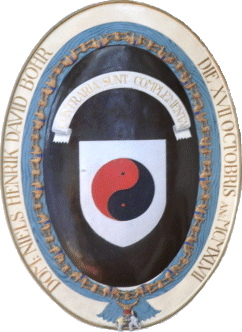
The arms bear the motto he used, Contraria sunt complementa (opposites are complementary)
Bohr’s philosophy followed the yin-yang thinking of the Eastern Taiji diagram
For thousands of years the West accepted as an iron law, in the natural sciences and the humanities, the basic idea, grounded in causality, that “opposites are in opposition.” Leaning on causality, the philosophy of being and opposition, the West even came to attempt the conquest of nature through science. But “chaos theory” forced human beings to give up the dream, too, that they could predict outcomes in the natural world. This field made our limits clear, especially in weather forecasting. As late as the 1960s people believed that, with the development of computers, advanced calculation had become possible and complex combinations of cases could be controlled, and so that human beings could control the weather. But it soon became clear that this was a concept that overlooked the possibility of chaos. In climate change there is the theory of the butterfly effect (Butterfly Effect): the possibility that a butterfly flapping its wings in Beijing may change the weather in Washington. Human beings came to accept that in climate change short-term prediction is possible but long-term prediction is not. Human beings could not but accept that at every point in every process, the possibility of change in a new direction always lies in wait.
Heisenberg (Werner Karl Heisenberg, 1901–1976) received the Nobel Prize in Physics in 1932 for the creation of quantum mechanics, and is well known for the “uncertainty principle.” Observing motion within the quantum, he found that it is impossible to fix a definite position, and that, at the same time, the observer’s intervention affects that position. He established his theory by abandoning definite concepts such as the absoluteness rooted in causality, which had formed the foundation of Western science, and accepting the concept of uncertainty, rooted in probability. The principles of complementarity and uncertainty are bound up with a worldview in which the foundation of the physical reality that makes up the universe may mean indeterminacy.
Newton’s physics rests on perfect causality. But twentieth-century Western quantum theory, after decades of agonising, made Westerners give up the causality they had cherished so dearly. The maxim “nature does not leap,” which Western scientists and metaphysicians revered as a law of nature, was destroyed. Causality had to be abandoned in the face of the astonishing discovery that electrons actually leap (quantum jump) between the ground state (基礎狀態) and the excited state (勵起狀態).129 Gradualism, the powerful foundation that had upheld Western culture, collapsed before the fact that electrons have discrete energy. On the basis of this discovery about the motion of electrons, a new kind of light, the laser, was developed. When they had to accept, regarding the nature of light that Westerners had long agonised over, that it has both the properties of a wave and of a particle, a contradiction that by Western concepts is an antinomy, and when they discovered that the smallest particles split, beyond protons, electrons and neutrons, into hundreds of elementary particles, they could not but give up at once their conviction about the nature of matter and the grasp of the smallest particle, and their faith in absolute truth.
Looking at the philosophical systems on which classical and modern physics rely, the philosophical system modern physics offers truly means a paradigm shift in the history of Western thought, because the philosophical systems on which revealed religion, the manifest of Socrates, Plato and Aristotle, Descartes’s rationalism, the metaphysics of Kant and Hegel, the way of Darwin’s theory of evolution, Western ideologies and Social Darwinism rested were all formed within the philosophical system of Western classical physics. The claim of “the absolutisation of mental ability,” which came to prevail in revealed religion and in Western philosophy after Socrates, fitted well, as metaphysics, with Western science as the philosophical theory religion needed. But when modern physics destroyed the absoluteness that classical physics had asserted, Euclidean geometry and Newton’s mechanics, the foundation of the absoluteness on which theology and metaphysics had relied for some two thousand years, came up against their limits.
Causality vs Probability: Which Is the Nature of the Universe?
We live in a single universe, yet the laws that explain that universe are opposite depending on “scale”: this emerges as the greatest contradiction in modern physics. Einstein holds that the microscopic world too must in the end run on minute causal laws we do not know (hidden variables), and that the universe cannot possibly run on probability, like a game of dice. Bohr rebuts him with quantum mechanics: the causality of the macroscopic world is in fact only an “illusion” that appears when countless quantum probabilities add up statistically, and at bottom it is probability. Which is right?
Classical physics and modern physics reach different conclusions about the nature of the universe. “The causality and determinism of classical physics” vs “the probability and indeterminism of modern physics” explain the nature of the universe. This is the debate on cosmology and on the view of the world that came to light in the dispute between Bohr and Einstein. There was a debate between Niels Bohr and Einstein over whether the two philosophical systems, those of classical and of modern physics, are separate or can be joined into one. Opposing Niels Bohr’s theory that the quantum world can be interpreted only in terms of probability, Einstein argued for deterministic causality. Einstein argued that the two philosophical systems could be joined, and that there must be a theory we had not yet discovered.
Einstein’s theory of relativity is “a theory of modern physics,” yet it supports “the causality of classical physics.” Relativity destroys the concepts of absolute time and absolute space upheld in Newton’s physics, but at the same time it extends Newton’s causality to the space of the universe and proves it there.130 Starting from the fact that the speed of light is constant, Einstein overthrew Newton’s absolute time. He proved that time flows differently depending on the observer’s speed and the strength of gravity: he denied “absolute simultaneity.” At the same time he held fast to causality. Time may be relative, but he defended causality by establishing the principle that information cannot travel faster than light. If event A is the cause of event B, then for every observer A must occur before B. He preserved the order of before and after, in which the cause precedes the effect. Relativity is a theory of wider scope that includes Newton’s mechanics as a special case (low speed and weak gravity). It explains even the realms of extreme speed (speeds close to that of light) and immense gravity that Newtonian mechanics cannot explain.131
Newton and Einstein proved in the language of science the conviction that “the universe is a system that runs, meshed by intricate causal connections, like a giant clockwork.” The difference is that Newton saw bodies moving causally on the stage of absolute time and space, while Einstein saw even time and space not as a fixed stage but as a physical reality (spacetime) that is curved by matter and energy and interacts with them.132 But Newton and Einstein were both thoroughgoing determinists and causalists.
Denying the probability upheld in quantum mechanics, Einstein said, “God does not play dice.” This famous remark shows well the philosophical conviction he held between the two pillars of physics, the causality of classical physics and the probability of quantum mechanics. Going beyond merely encompassing Newtonian physics, Einstein believed that the probabilistic character of quantum mechanics was incomplete, and that deterministic “hidden variables” must exist behind it. Rebutting the indeterminate explanations of the quantum physicists, he put forward a theory against the “indeterminism” that quantum mechanics presents. For he objected that, while in classical mechanics knowing the cause lets one predict the effect exactly, in quantum mechanics the state of a particle exists only probabilistically. He held that the laws of nature must be fundamentally clear and causal, and that the reason we rely on probability (dice) is that quantum mechanics still rests on an incomplete theory that cannot yet explain nature perfectly.
The quantum physicist Bohr, on the contrary, explained that the fundamental principle of nature is itself probabilistic, and that the state of a particle is not determined until it is measured. Einstein assumed that the probability of quantum mechanics would be included, as one phenomenon, within “a greater theory governed by causality.” The quantum mechanics led by Niels Bohr and Heisenberg cracked this deep-rooted determinism. They understood that the position and momentum of a particle cannot both be known exactly at the same time, and that this is not a limit of human measuring technique but the nature of nature itself. They explained that the future is not determined as a single outcome, but that several possibilities are superposed probabilistically.133
Einstein’s claim that hidden variables would be found behind quantum mechanics and that everything would come down to causality was put to the test by later scientists. In 1964 Bell proved mathematically that the “local hidden variables” Einstein had proposed could not account for all the predictions of quantum mechanics, and the countless experiments carried out since have supported the probabilistic interpretation of quantum mechanics over Einstein’s determinism. The 2022 Nobel Prize in Physics went to the scientists who confirmed Bell’s theorem experimentally. Bell’s work carries on today as a key foundation of advanced technologies such as quantum computing, quantum cryptography and quantum networks. When modern physics split open the “being” called the atom and went inside, what finally appeared was not particles but the “change” of energy. This suggests that the Western inquiry into being has, in quantum mechanics, ended by reaching the Eastern conclusion of change. Throughout the first half of the twentieth century, when quantum mechanics was born, Western science came to understand “the Eastern algebraic philosophy of change.” This is tied directly to algorithmic thinking. Eastern science aimed at a way of thinking centred not on “proof” but on “solution,” that is, on shu (術). Western geometry concentrates on proving unchanging truths: “Why is the sum of the interior angles of this triangle 180 degrees?” This is the realm of definition and causality. Eastern algebra, however, concentrates on “Given this situation (the area of a field, taxes and so on), by what steps shall we find the answer?” Classics such as the Nine Chapters set out a great many problems and the shu (術) for solving them. This is precisely the “procedural solution” that is the essence of the modern algorithm. Algebra values the Eastern thought of yi (易), which is not fixed substance but “change and relation.”
An algorithm deals not with a static figure but with a process in which states change as data flows. Focused on this character of change, it revises its path according to circumstances through the solutions set out as algorithms. This resembles not a fixed philosophy of being but the thought of change of the Zhouyi (周易), which shifts with the surrounding environment and context. Algebra has probabilistic acceptance at its core. Today’s complex algorithms (AI and the like) find the best solution not from a single absolute cause but by calculating the correlations and probabilities among countless variables. This connects with the “aesthetics of relation” that Eastern algebra pursued. Algebra shares the two essences that yin and yang provide, and the origin of information processing. At the most fundamental point, the algorithm (computer science) is of a piece with Eastern philosophy. Leibniz valued the Zhouyi. Leibniz, a pioneer of modern mathematics, conceived the binary system (0 and 1) and then, on seeing the sixty-four hexagrams of the Zhouyi, became convinced of its principle. The system of the Zhouyi, which explains the changes of all things in the universe through combinations of “being (yang, 1)” and “nothing (yin, 0),” becomes the metaphysical foundation of modern digital algorithms. Geometric figures are fixed in space, but algorithms, which follow dynamic rather than static rules, follow a flow in time: input → processing (step-by-step procedure) → output. Algebra concentrates on solving probabilistic problems. Today’s algorithms do not stop at proving a single right answer; in complex situations they display the art of handling things: “how can we reach the answer most efficiently?”
In the end, between Bohr’s view and Einstein’s on quantum mechanics, the discoveries so far support Bohr’s. That is, the probability of the quantum world exists, contrary to Einstein’s claim, as a reality of the one universe. Yet the theory of relativity continues to show that causality is at work in the universe. If so, we must take it that the debate on the nature of the universe we set out to examine, “causality vs probability,” goes on without a conclusion. The point where causality and probability collide is the greatest rift, and the central question, that science has faced since the arrival of modern physics. To date, in science, the macroscopic world (the cosmos) is governed by “deterministic causality” and the microscopic world (the quantum) by “stochastic probability.” The macroscopic world is the “deterministic world” governed by relativity and causality. It is the world of the cosmos, the planets and the everyday scale on which we live. The laws that govern it are Einstein’s theory of relativity and Newton’s mechanics. If you know the cause, you can predict the effect with 100 percent certainty. For example, the orbit of a planet or the point where a shell lands can be calculated without error once the initial conditions are known. Philosophically, the conclusion is that “the future is already determined within the causal connections of past and present.” The microscopic world, by contrast, is the “indeterministic world” governed by quantum mechanics and probability. It is the world of electrons, photons and the like, smaller than the atom. The law that governs here is quantum mechanics. Its principle is the uncertainty principle: the position and momentum of a particle cannot both be fixed at the same time. Where an electron will be exists only as a “probability,” and its position is determined only at the moment of observation. Philosophically, the conclusion is that “the essence of nature is chance and probability, and several possibilities are superposed.” So we come to hold two worldviews, that of the macroscopic world and that of the microscopic world. We “seem to live in a causal macroscopic world, but its roots are made of a probabilistic microscopic world.”
In the end, the worlds of science and philosophy use both causality–opposition and probability–complementarity, that is, both the Western and the Eastern philosophical systems: they use the thought of East and West that sprang from both the concept of God and the concept of the Dao. A “philosophical” and “rational” decision about which is right, God or the Dao, therefore has little relevance to our real lives. The concepts of God and the Dao coexist with us within the civilisations of East and West as the thought of yin and yang and the thought of good and evil, according to the principle of self-preservation.134 By philosophical analysis, the thought of yin and yang has staying power, and the thought of good and evil is powerful but risks self-contradiction. But from the standpoint of instinct, faithful to self-preservation, the thought of good and evil and revealed religion still provide human beings with something they need. In the end, just as we need both the causality of classical physics and the probability of modern physics, the thought of good and evil and the thought of yin and yang simply show, through the civilisations of East and West, two sides of how human beings see the cosmos and human affairs.
3) The Dialogue of the Dao and God in the Seventeenth and Eighteenth Centuries
We have so far looked at the Dao of the East and God of the West. We analysed the views of the cosmos contained in the concepts of the Dao and God, and compared what civilisations these views gave to the human beings who survived in East and West. The two concepts arose and grew separately, without connection, for thousands of years. East and West had exchanged goods along the Silk Road since before the Common Era, but the exchange stopped at goods; with philosophy having to cross countless borders of different languages on a journey that took two years one way, the essence of civilisation was not passed on. From the sixteenth and seventeenth centuries on, however, as direct sea routes between East and West were opened, exchange of people and philosophy became possible. At last the two philosophical systems, the Dao of the East and God of the West, met.
This meeting of East and West came about through the Westerners who set out in the Age of Discovery. Indeed, in the Age of Discovery, which accomplished the West’s conquest of the world, Western missionaries accompanied the conquerors. As Confucian and Daoist books were introduced to the West by the missionaries sent to China, Western thinkers came into contact with Eastern natural philosophy. Because Westerners had served revealed religion so deeply and so long, they thought every civilisation must have a religion, and called Confucianism and Daoism religions, natural religions. But Confucianism and Daoism have nothing that could be called a religion: no God and no prophets. Some Daoists did deify Daoist figures in folk belief after Buddhism entered the East, but the Daodejing and the Daoist scriptures have no religious content. In timing, too, as the West entered the Enlightenment, it took a deep interest in the “natural philosophy” of the East, set against its revealed religion.135 Apart from this philosophical interest, however, what appeared in history was a clash between Confucianism and Christianity.
Around the time deism was spreading in the West, Jesuit missionaries sent by the Roman Curia, following the zeal for mission, came to the East, spread the Christian spirit and began a dialogue with the East. As the West entered the age of deism, the Enlightenment of the seventeenth and eighteenth centuries, East and West could at last begin a philosophical exchange of thought.136 This philosophical exchange ought to have begun with a comparison of the Dao and God, but because of the historical circumstances of the time it became a comparison of Confucius and Jesus instead of Laozi and Moses. Because Confucius, too, acknowledged the Dao of nature, and Christianity shared the God of the Old Testament with Judaism, the comparison of the Dao and God took place indirectly through the comparison of Confucianism and Christianity. So instead of a direct comparison between the Dao of nature and the supernatural God, it turned into the question of ancestor worship and the worship of God. Confucius and the rites for ancestors became the West’s greatest concern.
The first famous Western missionary to reach the East along Vasco da Gama’s sea route was Matteo Ricci (1552–1610). Ricci arrived in Macao in 1582 and lived in China until his death in Beijing in 1610, learning the Chinese language and culture. Serving as an adviser to the imperial court, with the court’s permission he even published in Chinese The True Meaning of the Lord of Heaven (天主實義), which introduced the Western concept of God to the East through Catholicism. As a Christian he came to learn Confucianism, and when he died he was buried at a Buddhist temple in Beijing. Ricci was zealous in spreading Western thought in China through Christianity, but by translating the Analects and other works for the West he also made a decisive contribution to spreading Eastern thought in the West.
As the Jesuit missionaries of the West, led by Matteo Ricci, spread Eastern thought in the West, it became greatly fashionable and was welcomed by the thinkers of the Western Enlightenment. At the time the West was trying to re-examine its traditions, religion included, and to instil mental and rational thinking in every area. Because the Eastern thought that happened to arrive in the West at this moment rejected dogma, miracles and superstition and strongly emphasised the mental side, it had a great positive influence among the Enlightenment thinkers who could encounter it.
The dialogue between the Dao and God at that time went on on two fronts: in the East, dialogue and conflict between Confucianism and Catholicism; in the West, dialogue and conflict between the civilisations of East and West at large. At first China opened the way for Matteo Ricci to preach Catholicism. By the time of his mission, the conditions for Western thought to spread in the East were already in place. Because Eastern thought had a syncretic side, the central attitude was to open one’s mind to every religion and philosophy that helps human beings. At the same time, the chiming clocks and other refined scientific machines Ricci brought, and his knowledge of maps of the world, showed the East a new world, and this science and technology worked very positively. The Jesuit fathers in Beijing came to see that the Confucian ancestral rites and Christian worship of God could coexist. So they argued for allowing ancestral rites in the Christian mission, and there was an attempt to begin a dialogue between the civilisations of East and West through this.
In the East, the Kangxi Emperor of the Qing issued in 1692 the Edict of Toleration (容教令), which permitted the preaching of all religions, Christianity included. Under this edict Christianity was allowed to preach freely, and this was a part that the West, if anything, found hard to understand, because of the intolerant thought of the one God it believed in.
On this open ground of the East, in contrast with the intolerant current of Western religion, China in the seventeenth century was ready to begin a serious dialogue between the civilisations of East and West, between the Dao of the East and God of the West, and between Confucianism and Catholicism. Through the efforts of Matteo Ricci and others, the Western side, too, took the stance in its mission of respecting Eastern traditions and customs for the sake of dialogue with Eastern thought. The instruction that the papal Sacred Congregation for the Propagation of the Faith (布敎聖省) gave in 1659 to missionaries leaving for Asia reads:
Do not act out of zeal. Do not argue with the people of that country to make them change their rites or customs, unless those rites or customs are clearly contrary to Christian doctrine and morality. It would be very foolish for us to strive to take France, Spain, Italy or other European countries to China to be copied by the Chinese. Nor should you force them to become like European countries. Give them instead the faith, a faith that must not deny or damage their rites or customs. Unless it is a grave matter, keep and protect what is theirs.137
But this tolerant attitude of the Jesuit fathers was soon challenged by the Spanish Dominican friars living in the Philippines. They put forward three main points: forbid the rites for Confucius; forbid the rites for ancestors; and oppose the practice of the Jesuit fathers, centred on the French, of calling the Christian God Heaven (天) or Shangdi (上帝), calling him only Tianzhu (天主, the Lord of Heaven).138
The dispute was taken so seriously that the Roman Curia became involved. In the fight between the Jesuits in Beijing and the Dominican friars of the Philippines, the pope of the day, Clement XI, sided with the Dominicans. In 1704 he issued a papal decree that forbade Chinese Christians to perform rites for Confucius and their ancestors, forbade calling the Christian God Tian or Shangdi, and required that he be called only Tianzhu (天主). In 1705 Clement XI sent a special envoy to deliver the decree to the Kangxi Emperor.
How did the Kangxi Emperor treat the special envoy? He expelled him to Macao. The pope responded firmly, promulgating a papal bull that officially forbade the Chinese rites and customs. The Kangxi Emperor responded just as firmly, issuing an edict in 1721 that forbade the preaching of Catholicism in China. In the edict Kangxi commented on the pope’s position as follows:
Having read the pope’s decree, I have come to see that the Westerners are truly narrow-minded. I have concluded that one cannot talk with Westerners on the level of the mind, because they do not understand our Chinese way of concentrating on the great questions. I cannot meet a single Westerner who understands Chinese civilisation, and their words and deeds are truly unbelievable and foolish. Seeing the pope’s decree, their religion is really no different from the small and stubborn Buddhism or Daoism of the East. I have never seen a document containing so many foolish claims. From now on, to avoid further trouble, I forbid the Westerners to preach.139
This disagreement between the pope and the Chinese emperor soon led to disputes among the Catholic believers and groups of priests within China. Chinese Catholics came out in support of the Jesuit fathers, while the pope’s ban on Confucian rites was supported by the Dominican friars and bishops in China who had come from the Iberian Peninsula. As trouble arose at home, the Chinese government stepped up its suppression of Catholicism, and finally, in 1724, the Yongzheng Emperor reinforced his father Kangxi’s decision, banned Catholicism and expelled to Macau all the priests except those working at the court in Beijing.140
The thinkers of the late Enlightenment came to seek a republic rather than an enlightened monarch. As they revived the study of ancient Greece and Rome and came to want the republican government that the East did not have, an overall negative view of Eastern thought spread. At about the same time, opinion in China turned against the Western missionaries, and they were expelled. Western intellectuals began to judge China still more negatively for this. Behind it lay, in large part, the West’s conquest of the East on the strength of the success of the Industrial Revolution. Above all, they came to judge that Eastern civilisation was lacking on the side of the mind. This rested on the mind-centred rationalism that had led the philosophical systems of the Western continent since Descartes.
Despite Matteo Ricci’s efforts, in the end the Catholic mission achieved no great results in China in the sixteenth and seventeenth centuries. Philosophically, because the Daoist thought of the Dao of nature and the Confucian thought that rejects miracles and superstition had taken root early, there was little room for a miracle-working, anthropomorphised God, which plays an important role in Christian doctrine, to find its way in. In practice, the clash between the Roman Curia and the Chinese court described above came to obstruct daily life. In the end the path of dialogue and interaction was blocked: between Eastern and Western civilisation, and between the philosophical systems of the Dao of the East and God of the West.
Western Deism (理神論) and Empiricism, and the Natural Philosophy of the East
In the dialogue between the Dao and God, though there were obstacles to dialogue between states during the Enlightenment, there was a period when it worked positively in the philosophical thought of East and West. With the rise of deism in the West, people came to doubt God’s miraculous acts and to judge favourably the natural philosophy of the East, which does not accept miracles. At the same time, as British empiricism came to value nature, it shared a philosophical parallel with Eastern natural philosophy.
The greatest problem between the systems of revealed religion and natural philosophy is the judgement of miracles. In the West the question of miracles was raised fundamentally in the eighteenth century. For some two or three thousand years, revealed religion had taken miracles for granted as the role of a supernatural God. But in the East the question of miracles had already been clearly settled before the Common Era, in the Spring and Autumn and Warring States periods, by Daoism and Confucianism, and further by Xunzi. This influence of Eastern natural philosophy had a direct influence on Western deism. In the world of Western thought, too, there were those who thought Eastern thought deistic. They saw China as the only civilisation in the world with a deistic system, and thought that Eastern civilisation had a deism that relied not on the authority of church or revelation but on the light of the mind, which every human being has. They judged that Confucian ethics had the same value as the teachings of Christianity, but were grounded in the mind rather than revelation.141 They approached Eastern Confucianism and Daoism very favourably.
Western deism arose in the late seventeenth century and dominated Western thought for about a hundred years. Deism reached its height at the French Revolution in the late eighteenth century, when the revolutionary government even proclaimed it the state religion of the French Republic. Deism was developed through the contributions of many thinkers and scientists of the Enlightenment in the West, and most of the leaders who built America were deists. The American Constitution, which permitted freedom of religion, came out of deism. Deism was promoted mainly by thinkers of the Continent and came into full bloom with Spinoza, and then Voltaire and Rousseau. But because the power of religion remained strong even in the Enlightenment, they had either to hide their thoughts, like Spinoza, or, like Voltaire and Rousseau, publish them bravely and flee from place to place to escape arrest and persecution.142
While the thinkers of the Continent passed through the Western Enlightenment against the background of deism, British thinkers pursued a different philosophical pattern, putting forward as their central philosophical current not Continental rationalism but British empiricism. Rationalism and empiricism both moved away from the supernaturalism of the traditional Christian God and came to centre on the human mind and nature. Rationalism regarded the mind as the foundation of knowledge, valued innate ideas and, on the basis of deductive reasoning, contributed to the development of science, metaphysics and moral philosophy. British empiricism, arguing that all knowledge comes from sensory experience, put forward an inductive method of reasoning that valued observation and experience in nature.
Rationalism, relying on the mind, argued that human knowledge is “intellectual and deductive” and is proved by geometry, mathematics, ethics and metaphysics. Empiricism argued that human knowledge is proved “inductively, according to the senses,” and must not rely on innate ideas (innatism) or tradition. To keep innate ideas and tradition at a distance, they strove to take “nature” as their foundation. The works of Bacon, Locke and Hume stress an empiricism centred on nature.
In this respect Western empiricists resemble the civilisation of the Dao of the East, which believes in “nature as absolute truth.” But because the power of religion already weighed heavily on Western thinkers, the resemblance actually reflected in their philosophy is not great. Eastern civilisation arrives at the thought of the Dao on the basis of a pure empiricism kept, without preconception, for thousands of years, and the thought of the Dao has the unmanifest at its core. But most Western empiricists held the manifest view, believing in the existence of God. So their philosophy approached nature not on the level of a grand discourse comparing God and nature (the Dao), but on the level of epistemology.
And many empiricists argued for the blank slate in epistemology. The blank slate does not recognise the human nature of “freedom within fate.” Human nature as Eastern civilisation grasped it focuses on limiting human possibility to the level of “instinct,” but the blank slate rejects any limit on human possibility. Rather, in opening up infinite human possibility, the blank slate resembles rationalism. So Western empiricists did not reach the point of discussing the fundamental characteristics Eastern civilisation asserts: the unmanifest, probability, relativity and complementarity. Naturally their thought remained within the grand discourse of Western civilisation: manifestation, causality, absoluteness and opposition. Within this large frame, Western empiricists debated epistemology, which seeks certainty in philosophy. In Western epistemology, besides rationalism and empiricism, we can also look at scepticism.
Scepticism is expressed as doubting the knowledge of rationalism and empiricism. In antiquity it doubted the philosophy of Socrates, Plato and Aristotle; in the Renaissance it doubted scholasticism and Calvinism; in the early modern period it played the role of doubting Cartesianism, which represented rationalism. Western scepticism has something in common with the Eastern unmanifest. The unmanifest believes in absolute truth but opposes human beings expressing it. Western scepticism differs from the unmanifest in doubting not only the expression but the very existence of absolute truth. In this respect scepticism as modern Western philosophy differs from the scepticism of pre-Socratic Greek philosophy, which was like the unmanifest. Those Greek philosophers, like the Eastern unmanifest, took issue not with the existence of the absolute but with its expression.
In the Enlightenment of the seventeenth and eighteenth centuries, Britain, reacting against rationalism, argued for empiricism and developed a philosophy in which empiricism must take nature as its centre. British thinkers contributed to the development of the Western Enlightenment through naturalism and empiricism. But up to the eighteenth-century thinker Hume, they remained conservative where religion was concerned. Bacon (1561–1626) argued clearly for the importance of nature, yet took the position that it does not conflict with Scripture and faith. He argued that because all human knowledge comes from nature, experience through observation is important, yet he thought that Scripture and nature were both revelations of God. He criticised Aristotle’s deductive method and advocated an inductive empiricism through observation and experiment. Locke (1632–1704) argued for the empiricist blank slate, that human cognition is formed through experience after birth, together with a social contract theory in which human beings with the right of self-determination aim at liberalism. This contributed to the founding ideals of the American Constitution. At the same time, while advocating tolerance, the motto of the Enlightenment, he held that government should not tolerate atheists. Where Scripture was concerned, he sought to believe it as written, creation and miracles included.
In Britain this power of religion continued. Hume (1711–1776), who had great philosophical influence after his death, was not appointed to a professorship because of his sceptical view of religion, and suffered continued harm. Hume argued that the human mind is too limited to understand the nature of God, and that religious belief rests on feeling and habit rather than on the mind. His major work, Dialogues Concerning Natural Religion, too, was published anonymously after his death. His ethics and epistemology were not appreciated in his own day but won independent fame after his death. In this book he explains his own position through a dialogue among three people: a traditional theist, a proponent of natural religion and a sceptic. The West renders “sceptics” as doubters and judges that this represents Hume’s philosophy. But as explained in the assessment of the Greek philosophers, the Western sceptics can be seen as having almost the same philosophical system as the natural philosophers of the East.143 In this respect Hume differs from Bacon, Berkeley and Locke, who developed empiricist philosophy within the system of revealed religion. Hume becomes a philosopher who developed a natural philosophy free from revealed religion.144 In terms of philosophical thought, Hume’s philosophy forms a “parallelism” with the natural philosophy of the East.
4) The Meeting of Eastern and Western Thought: Confucius and Voltaire, Laozi and Rousseau, Xunzi and Spinoza
Among the thinkers of East and West, there are some who played the role of grafting the civilisations of East and West together. Three stand out: Spinoza (1632–1677), Voltaire (1694–1778) and Rousseau (1712–1778). Because Spinoza, Voltaire and Rousseau in the West followed, directly or indirectly, the same philosophical systems as Xunzi, Confucius and Laozi in the East, comparing them lets us discover an interesting meeting of the philosophical systems of the Dao and God of East and West.
Spinoza was a philosopher who developed the astonishing thought that identified nature (the Dao) with God. His philosophical system so closely resembles Daoism and, above all, the philosophical system of Xunzi, that they are hard to tell apart. The Jewish mysticism of the Kabbalah, which influenced Spinoza, put forward concepts very like the Dao. Among the concepts the Kabbalah values are basic ones that correspond to the Dao: Ein Sof and the Sephirot, the concepts of “infinite being” and of being “immanent in all things.”145
God is an infinite and ineffable being. No concept can define him. (Ein Sof)
God is not a being outside the world, but is immanent in the world and present in all things. (Sephirot)
These descriptions express precisely the features of the natural philosophy of the Dao of the East. Spinoza’s famous idea of “God or Nature” comes from the Kabbalah. According to this philosophy, the God of Western revealed religion and the Dao of Eastern natural philosophy must become the same. For this reason, among Western philosophers, Malebranche in France and Hegel in Germany interpreted Spinoza as repeating Eastern philosophy.146
After Spinoza, through Voltaire and Rousseau, we can look at the conflict and harmony between the Dao and God. Spinoza came before Voltaire and Rousseau in time, but his thought can be judged more groundbreaking than theirs. Had Voltaire and Rousseau, like Spinoza, identified nature and God, then, given the power structure of eighteenth-century Western thought, their philosophical activity would not have drawn people’s interest. In the West of the time, a deist standpoint could be accepted, but the claim that “nature itself is God” could only be rejected and fiercely opposed, or received with philosophical indifference as too far ahead of its time. In this respect a true comparison of Eastern and Western thought is difficult until the West has fully understood Spinoza’s philosophy.
But because this beginning is so hard, Western philosophers still go on avoiding or fearing it, because it takes the courage to turn the Western manifest upside down entirely. In the history of Western philosophy, too, the philosophers after Spinoza came into contact with Eastern natural philosophy while avoiding Spinoza’s key point that “nature and God are the same.” Within the bounds of so-called deism, they approached Western revealed religion and the system of Eastern natural philosophy separately.
After Spinoza, Voltaire and Rousseau developed philosophical systems like the natural philosophy of the East. Voltaire was inspired by the natural philosophy of Confucianism, and Rousseau expressed a philosophical system very like Daoist thought. The American philosopher Will Durant also pointed out the similarities between Rousseau and Voltaire and Eastern thought:
Rousseau’s philosophy so resembled that of the Chinese Daoist philosophers that we find ourselves comparing Rousseau with Laozi and Zhuangzi, for the same reason that Voltaire is compared with Confucius and Mencius: he thought so much as they did.147
Voltaire openly revered Confucius, and Rousseau developed thought very like the philosophical system of Daoism. Most Westerners and most Easterners miss this point. In the age of deism, Western philosophers were wrestling with the problems of Western revealed religion, and against them drew much inspiration from the philosophical system Eastern natural philosophy offered.148 Considering Spinoza’s revolutionary philosophical system towards revealed religion, the limited scope of Rousseau’s activity in terms of East-West comparison resembles Voltaire’s. Because Spinoza’s view of God as nature was regarded in the thought of the time as denying God, that is, as atheism, Rousseau seems to have acted with this in mind. As a result, rather than denying God directly, Rousseau criticised civilisation itself, which the human beings God created had produced, and argued that we must return to the state of nature. Even so, Rousseau’s critique of civilisation was suppressed by the religious and secular authorities of the time, and his books were banned several times. Rousseau, too, like Voltaire, had to flee to many places for the sake of freedom of thought.
In his Ethics Spinoza argued clearly that “nature is God” and built a systematic thought. Through this we can find a great resemblance to the Daoist thought that understands the relationship between humanity and nature as the Dao. Rousseau, on the other hand, stressed that human beings should return to the state of nature, but unlike Spinoza he acknowledged the need for religion. The important point distinguishing Rousseau from Spinoza is that Rousseau did not deny that the foundation of Western civilisation was God and religion. Because Rousseau never explicitly claimed that “God and nature are the same,” the resemblance between his thought and Daoist thought is not as plain as that between Spinoza and the natural philosophy expressed in Daoism. Nonetheless, in that his thought centres fundamentally on the essence of the relationship between humanity and nature and looks at civilisation critically, it can be said to have much in common with Daoist thought.
That this resemblance has hardly been pointed out is because Western thinkers did not know Daoism. Eastern thinkers, on the other hand, tried to understand Rousseau only in the context of the history of Western philosophy, and made almost no effort to compare him with Eastern thought, especially Daoist thought. Apart from Spinoza, it is hard to find a Western thinker whose thinking on the relationship between humanity and nature is as close to Daoism as Rousseau’s. Approaching Rousseau from this standpoint is therefore a great help in understanding Daoism for Westerners, and Rousseau’s thought for Easterners.
Voltaire and Confucius: “God Has No Need of Human Sacrifice or Prayer”
Voltaire held Confucian thought in high regard and drew heavily on Eastern natural philosophy to guide the Western Enlightenment. In 1755 he published the play The Orphan of China (L’Orphelin de la Chine), in which he sought to explain to the West the moral order of Eastern natural philosophy. It is an adaptation of The Orphan of Zhao (趙氏孤兒), a play written in China’s Yuan dynasty. The plot tells how, after the Zhao, a noble family of the state of Jin, are wiped out, the only baby to survive grows up, avenges his family and restores justice. In it Voltaire sought to express the Eastern philosophy grounded in Confucian natural philosophy, and set it out as the direction the West should learn from in the age after the Enlightenment.
Voltaire thought that “the need for prayer, rites and sacrifice is something human beings need, not something God needs.” This is like the thought of Confucius in the East. Confucius argued that worship of the spirits is not essential to human beings, and that since human relationships matter more, we should concentrate on ren.
Confucius: Respect the spirits, but keep them at a distance (Analects, “Yong Ye,” 20). The leader (junzi, 君子) does not act contrary to ren even for the space of a single meal. (Analects, “Li Ren,” 5)
Voltaire: God has no need at all of our sacrifices or our prayers; it is only we who feel the need to offer them. It was not God who made us worship him, but we ourselves.149
Voltaire praised Confucian philosophy directly and left writings to that effect. He rated the role of Confucius highly and saw Confucianism as gathering the most useful lessons of political ethics in human history. Voltaire gives this assessment of Confucius:
What a trick of fate, and how shameful for us Westerners, that we can find a sage only at the far end of the East! He was simple, not grandiose, and no impostor, and in 600 BC, when the Greeks had barely learned to tell what wisdom was and the other peoples of northern Europe did not know what letters were, he was already teaching people how to live happily. He is Confucius. Among the teachers of antiquity, Confucius is the only one who never sought to deceive others. In all the world, who since Confucius has given a finer rule of conduct? “Affairs of state must be attended to as one attends to the affairs of one’s household. The household can be attended to only by setting an example…” We must frankly admit that no teacher has taught human beings a more useful truth than this.150
Comparing the natural philosophy of the East, represented by Confucianism and Daoism, with the revealed religion of the West, Voltaire pointed out:
The religion of the Chinese literati, too, is worthy of respect. They have no superstitions, no absurd legends, no dogmas that offend the mind and nature.151
Voltaire called himself a deist. Most of his writings centre on criticism of religious intolerance, dogma and what is contrary to the mind. Rousseau, on the other hand, proposed various theories and remedies about civilisation itself. Voltaire valued the mind; Rousseau valued feeling. The two remained rivals and kept up a competitive relationship. Rousseau won great support among the people and those of revolutionary temperament; Voltaire among the educated. Rousseau analysed human corruption and inequality at the level of civilisation and proposed remedies. Voltaire, working mainly at the level of religion and philosophy, stressed tolerance and the mind and criticised intolerance and irrational superstition.
During the Western Enlightenment the rational and mental side of Eastern civilisation held great appeal for Western thinkers. In the field of political ethics above all, Leibniz and Voltaire judged Eastern civilisation favourably and reflected it in their writings. In the field of political economy, Quesnay and Vincent de Gournay introduced concepts such as Daoism and the thought of wuwei, and passed their influence on to Adam Smith in Britain.
What the deists called into question was a God who works miracles. A miracle means a violation of natural phenomena. A God who works miracles can therefore only be a being separate from nature and transcending it. Greek myth shows well the process by which human beings came to be seen as separate from nature and, to a degree, as supernatural beings. And within the human awareness formed in this way, human beings can fall into the temptation of identifying themselves with God to magnify their own power. They come to want God to work supernatural miracles, against nature, on their behalf. Of the deists who opposed this doctrine, the representative figure is Voltaire, which is why he is regarded as the representative thinker of the Western Enlightenment.
After the Enlightenment, deism did not secure a place of its own as a philosophical system. But in denying miracles, revelation and the authority of the church, and seeking to understand God through nature and the mind, it has had a great influence on modern religious tolerance and rationalism. The influence of deism is also great in the fact that many deists are regarded as atheists, agnostics or secularists.
After the question of miracles, deism’s main problem with the God of the West was the problem of good and evil. Westerners had made God into a just and good God. Thinkers appeared who held that justice and goodness are only what human beings need, and that God must stand beyond justice and injustice, good and evil. Good and evil, as Spinoza said, come down in the end to what is good and bad for us.152 The natural phenomena of typhoons, floods, droughts or cold are neither good nor evil. Only human beings feel them as good (when they strike an enemy or foe) or bad (when they strike me). Russell (1872–1970) hoped that “if we used the concepts of liking and disliking instead of good and evil, we could live in a better world.”153
Western thinkers recognised at the same time the problems of the Judeo-Christian monotheistic definition of God and of deism. Nevertheless, the alternatives they offered all centred on the concept of God, because they were reluctant to introduce the concept of nature in place of God. By calling a God who does not intervene in the human world after creation the God of deism, and a God who stands for nature, identical with everything, the God of pantheism, they could not set up or define the relationship between nature and humanity without the concept of God. We even see a standpoint that has no concept of God at all being named “atheism.”154
Voltaire did not agree with Spinoza’s view of God as nature, the claim that “God is nature,” but he criticised Western tradition and religion from the standpoint of deism. Because the West of the eighteenth century was not yet ready to accept Spinoza’s view of God as nature fully, Voltaire made his criticism from the standpoint of deism. The situation in which Spinoza’s view was regarded as “atheism” continued even into the eighteenth-century Enlightenment. Even with the claims of deism alone, Voltaire came into danger, was imprisoned, and had to take refuge in many places for the sake of freedom of thought.
In the West a clash arose between orthodox Christianity and deism. Those who argued for deism, attacked the dogma, miracles, worship and other irrational elements of orthodox Christianity, and argued for tolerance were the Enlightenment thinkers. With deism, developed within the West itself, the West gained a foothold for understanding Eastern civilisation. The Eastern civilisation introduced to the West at that time was the thought of Confucius. Voltaire was captivated by the natural philosophy of Confucius. The French Enlightenment thinkers of the time took a favourable interest in, and a favourable view of, the tolerant religious outlook and the ethical system of the mind of the East.
France took an extraordinary interest in an ethical system grounded in the mind above all because of the deadly hatred between Catholics and Protestants. In the sixteenth and seventeenth centuries, Western thinkers, especially in France, had to face an environment of extreme religious intolerance. The Catholic Church tried to maintain its orthodoxy by various means, the Inquisition among them, and the conflict with Protestantism deepened especially after the Reformation began. As the Renaissance ended, the first edict of toleration in the West was issued: the Edict of Saint-Germain, proclaimed in 1562 by Catherine de’ Medici, who was acting as regent for King Charles IX. It was the first measure of toleration in almost 1,200 years since Christianity was proclaimed the state religion of the Roman Empire in the fourth century. But right after the edict was issued, Protestants were massacred in great numbers by Catholic forces, and the edict of toleration became practically meaningless. There followed in France the merciless French Wars of Religion (1562–1598) between Protestants and Catholics, which lasted thirty-six years. To bring this war to an end, an edict was issued granting freedom of belief to the Protestant Huguenots of France: the famous Edict of Nantes of Henry IV in 1598.
But beyond France, the wars between Protestants and Catholics were spreading across Europe. This was the terrible Thirty Years’ War (1618–1648), called “the last war of religion and the first world war,” in which all the states of Europe divided into Protestant and Catholic and fought each other. Having ended the war through the Peace of Westphalia, Europe at last entered a new world: nation-states that transcended religion appeared. And among these nation-states, the role of guaranteeing freedom of thought came to the fore and contributed to the realisation of Enlightenment thought.
But unexpectedly, in France, something happened that ran against this European toleration. The Edict of Fontainebleau, issued by Louis XIV, was proclaimed in 1685. It revoked the Edict of Nantes, which had guaranteed freedom of religion in 1598. As a result, hundreds of thousands of Protestant Huguenots left France. Three hundred years later, in 1985, President Mitterrand of France issued a declaration apologising to the French Protestants, the Huguenots, who had suffered from the Edict of Fontainebleau.
Louis XIV’s intolerant measure, however, was the partisan act of a king and did not have the people’s support. In these circumstances an extraordinary interest in Eastern civilisation, and especially in its tolerant religion, its ethics of the mind and the emperors of China as enlightened despots, began to arise, centred on French thinkers. France had suffered more than any other Western country from the intolerant struggle between Protestants and Catholics, so its thirst for a philosophy of tolerance was that much greater. So it was that, as deism developed in the West, Eastern thought flowed into Europe and spread widely, and deism was strongly influenced by Eastern thought in the course of its formation.
One thing is clear: through deism the West came much closer to the Eastern way of approaching nature. That is, it brought human beings closer to nature directly, without going through God. It did not develop into a living system of philosophy and ethics like the Dao of the East, but Western deism can be said to have much in common with Eastern Daoism in its interpretation of the relationship between humanity and nature.
Voltaire’s assessments of the East are well known, but the case of Rousseau and Spinoza is different. There is no evidence or account that they encountered Daoism or the Eastern thought of the Dao directly and were inspired by it. Yet the systems of thought they developed as they took an interest in natural philosophy resemble Eastern thought astonishingly.
Rousseau and Laozi: “Return to Nature”
Criticising the political and social situation that the French Ancien Régime stood for, Rousseau cried out that civilisation had led human beings away from nature. His appeal is often summed up as “Return to nature!”, though these words do not appear as such in his writings. With this call he fiercely criticised the artificial order of absolute monarchy and opened the floodgates of the French Revolution. In Germany, Herder, Goethe, Schiller and others resonated deeply with Rousseau’s cry, and young people launched the Sturm und Drang literary movement, pouring out fierce anger against the feudal order. A position like Rousseau’s, which thoroughly criticises the many fields of civilisation, politics, economy, art and ethics among them, is rare even among Western thinkers.
The Dao is a system of thought centred on “nature,” characterised as a natural philosophy set against Western revealed religion. Rousseau in the West, too, was a man who cried that “human beings must return to nature.” Rousseau was one of the Western thinkers who carried currents of Eastern thought into the West. But his attitude towards Eastern thought is mostly unknown, because not only did Rousseau not look favourably on Eastern thought, he also left writings that judged it negatively. Where he judged Eastern thought negatively, it mostly concerned Confucianism. In the later Enlightenment, regarding republicanism as the ideal political system, Rousseau regarded Confucianism as a thought that defended monarchy, and criticised and rejected it. So Rousseau’s thought is generally considered to have little to do with Eastern thought.
Yet Rousseau followed a philosophical system very like Daoist thought in the East. Rousseau’s critique of human civilisation above all, and his attempt to recover human character in its state before civilisation, look astonishingly like the Daoist thought of wuwei. On the other hand, no connection with Daoist thought can be found in the social contract theory and the claims about political systems that Rousseau put forward after his critique of civilisation. Those claims largely run against the basic thought of Daoism.
Rousseau’s groundbreaking thought on human civilisation is very like Daoist thought in its view of the cosmos centred on nothing (無), and in seeing wuwei as the conduct human beings should follow. Behind this lay the basic thought of respecting nature, different from revealed religion. So there is a side to Rousseau in which, like Daoism, he respected natural philosophy and urged human beings to return to nature.
Rousseau holds a unique and singular place among Western thinkers, because he deeply challenged the traditional Western thought, reigning for more than two thousand years, that interprets the relationship between humanity and nature through the being called God. Rousseau sought on many levels a direct connection between humanity and nature. His call to “return to nature” can be understood as criticising the problems of a Western civilisation based on revealed religion, pointing out that civilisation has alienated and cut human beings off from nature, and appealing to human beings to come back to nature.155
So Rousseau sought to look at the religion of the eighteenth century, and the whole of the Western civilisation connected with it, from a new perspective. Because his original ideas were shocking at the time, he opened new horizons in the history of Western civilisation through works that poured out one after another. Rousseau’s writings caused a great stir in the West of his day.156 To Westerners of the time, unfamiliar with Eastern civilisation and Daoist thought, his ideas were received as fresh and wondrous.
Rousseau argued that in the state of nature human beings lived without the constraints of law or morality, and that as cooperation in social life became necessary they left “the golden age that needed neither law nor morality.” This idea has something in common with the ideal age of Yao and Shun of which Confucianism speaks, and can also be seen as linked to the Daoist philosophy of nothing (無), its concept of the primordial society.
When the Dao is lost, virtue appears; when virtue is lost, ren appears; when ren is lost, righteousness appears; when righteousness is lost, rites appear. Rites are the thinning of loyalty and good faith, and the beginning of disorder. (Daodejing, chapter 38)
From the Daoist standpoint, Rousseau is a unique figure among Western thinkers, with insight into natural philosophy. Most Western thinkers criticised and compared other civilisations from the standpoint of revealed religion, a thought centred on being (有), but Rousseau put forward natural philosophy centred on nothing (無), like Daoism. Rousseau sought to overturn completely the Christian view of creation, the concept that an ordered world was born out of chaos. His central thought is that “human beings lived a happy life in nature, free, equal and full of love, but on entering society and civilisation they fell into a world of bondage, inequality and jealousy, and became unhappy.”
The foundation of Rousseau’s philosophy is like the Eastern philosophy of “keeping desires few and shallow” (情慾寡淺, a life of reducing and restraining desire), which holds that “the feelings and desires human beings have at birth are not originally great, but in human society they are artificially enlarged.” Rousseau did not see human beings as subjects of original sin or as specially created beings. Instead he regarded them as part of nature. Unlike most Western thinkers, who regarded civilisation as something to be proud of, Rousseau pointed to civilisation as the cause of human corruption. From this standpoint, like the core thought of Daoism, Rousseau saw a fundamental problem in the civilisation human beings had made.
Many Western thinkers pointed out the problems of civilisation. But most of them divided civilisation into its positive and negative sides, its beneficial and harmful parts; hardly any, like Rousseau, saw civilisation itself as negative and harmful. In Eastern civilisation, too, most thinkers, Confucians included, saw the problems of civilisation and society and proposed remedies or solutions. But Daoism saw an essential problem in civilisation itself, imagined the state of nature before civilisation, discovered the Dao there, and through it sought order in society and calm in the heart. So at the starting points of Rousseau’s thought and of Daoism we can find many similarities.
The more prohibitions there are in the world, the poorer the heart becomes;
The more conveniences of civilisation there are, the more disordered society becomes;
The more ingenuity develops, the more strange theories hold sway;
The more laws and institutions are put in order, the more thieves there are. (Daodejing, chapter 57)
Rousseau argued that human beings now have civilisation and language, but in the beginning had nothing. The civilisation of human society does not suit the original human being, so human beings cannot but be unhappy. In the same vein he argued that human beings once had a noble passion like that of animals, which they lost through language and the mind, and that in the end the mind only contributed to building a complex human society and was used negatively. At the time, under the influence of religion, Westerners held that human beings had had language from the moment God created them some four thousand years before Christ, and that the human beings God created had the same nature then as now. So to distinguish between the good original human being and the bad human being corrupted by civilisation was a revolutionary philosophy.
In this way Rousseau shocked the world of Western thought by freeing human nature from the influence of religion and presenting the human being as a being within nature. So Rousseau saw civilisation as always youwei (有爲) and artificial, producing inequality, envy and unnatural desires. He distinguished “self-love” (amour de soi) from “pride” (amour-propre). Self-love is a natural instinct for self-preservation, while pride is artificial: it provokes competition with others, creates needless anxiety and makes people take pleasure in others’ weaknesses and pain.
In the East, under the influence of Daoism and Confucianism, human nature had already been set within nature two thousand years before Rousseau was active. So to Easterners, most of Rousseau’s many ideas, apart from the social contract, are nothing new; they encounter them naturally and understand them easily. Daoism counts “not putting oneself ahead of others” (謙下不爭, humility without contention) among its important ethics: in competition with others, one must not put pride first. This in the Daodejing is very like the structure of self-love and pride that Rousseau argued for. The Daodejing holds that civilisation, language, pride and the like make human life complicated and difficult.
Do not exalt people for being wise, and quarrels among people will disappear.
Do not value what is precious, and there will be no stealing among people.
Do not desire what stirs up greed, and the heart will not be disturbed. (Daodejing, chapter 3)
Rousseau looked at the development of art and culture with a critical eye, in contrast with most Western thinkers, who were proud of the development of the arts and sciences and viewed it positively. Rousseau did not see the development of the arts and sciences as necessarily beneficial to humanity. He regarded them as products not of true human need but of pride and vanity. Further, he held that the arts and sciences corrupted human beings by making idle and luxurious lives possible. This view drew condemnation from many fellow artists who loved art. But Rousseau’s thought here is like the thought of the Daodejing.
The many colours blind the eye; the many tones deafen the ear;
The many dishes make one lose true taste. (Daodejing, chapter 12)
After the Daodejing, the Daoist thought developed in the Zhuangzi also contains aspects very like Rousseau’s thought:
Great knowledge is broad and at ease; small knowledge is petty and anxious.
Great speech is sparing and weighty; small speech is chattering and light. (Zhuangzi, Inner Chapters, “The Equality of Things”)
Rousseau argued that material progress harms true friendship, and that envy, fear and suspicion come to take its place. He believed that in the state of nature human beings have an originally good nature. As they began social life, people came to see themselves through the eyes of others, and as winning others’ favourable regard became important, the distortion of human character began. Through this change, he thought, the originally good nature went through a process of corruption.
This view that human nature is originally good has something in common with Mencius’s view that human nature is good. His stress on the importance of education, together with the claim that society and civilisation damage the good human nature, also resembles Mencius. Rousseau stressed the importance of education, and his philosophy of education focused not on the mere transmission of knowledge but on the ethical education of character. In this respect Rousseau’s thought can be said to run in the same vein as Eastern civilisation. His theory of education sought to set as its aim not the transmission of information or concepts but the development of the individual’s character and virtue, so that people could learn how to govern themselves. His final aim was for people to keep their virtue as they live, even in a complex and imperfect social environment.
Rousseau and the Dao of the East, then, are very alike in their diagnosis of human society and civilisation. In rejecting being and stressing the importance of nothing, Rousseau has much in common with Eastern Daoism. His bold attempt to connect humanity and nature directly, rather than through the God that traditional religion offers, is also deeply connected with the Dao. But the solutions Rousseau and the Daodejing offer are opposed. Rousseau’s solution is extreme, the exact opposite of the Dao’s thought of wuwei. His approach is not to accept the status quo but to overthrow it. And in his conviction that the alternatives he proposes can be realised, he differs greatly from the realism of the Dao.
The Dao includes both nothing and being; it regards nothing as more fundamental than being, but does not deny being altogether. In this Daoism differs from Rousseau, in recognising the need for being in human society. In how they diagnose the problems of civilisation and propose solutions, Rousseau’s thought and the thought of the Dao stand in sharp contrast. The proposals and solutions the Dao offers are all part of civilisation, and so rest on an affirmation of reality. So Daoism, for the sake of order and harmony in society and the well-being of the individual, points in a direction centred on the Dao, on wuwei, and on the ethics that come from them. Rousseau, on the other hand, with evident passion and conviction, proposes revolutionary solutions: new legal, institutional and ideological ways of overthrowing reality.
Rousseau passionately argued for liberty, equality and fraternity, the core ideals of the French Revolution. Other Enlightenment philosophers argued for equality too, but their equality remained within a traditional elitism, as it had been stressed since Aristotle. Rousseau, by contrast, stressed the equality of all human beings. In centring on all people, he resembles Daoism. But the difference from Daoism is that Rousseau argued for a new political system. Opposing aristocracy and monarchy, he argued for a republic for the sake of the equality of the people in the state.
To recover in society the liberty, equality and fraternity that human beings enjoyed in the state of nature, he put forward the theory of “popular sovereignty,” arguing that the exercise of state power must rest on “the general will” and could be decided by majority opinion in a republic of suitable size. Here lies the difference between Rousseau and Daoism, and it stems from their judgement of human nature. Rousseau seems to have seen human nature positively and imagined that people would agree to the idea of popular sovereignty. But Daoism never departed from the realism that human nature always pursues its own interest. This difference between the Daodejing and Rousseau over human nature becomes clear when we look at how Rousseau’s revolutionary thought played out in history. In history Rousseau’s theories of popular sovereignty and the general will did not in fact reflect the will of all; they went in the direction of crushing minority opinions and views. The French Revolution, lost under the rule of the masses, unfolded in the direction of extreme Jacobinism.
Rousseau criticised the institution of private property above all. He saw private property as the beginning of civilisation, and the beginning of all inequality, murder and war. He held that the division of labour among people and the institution of private property that arose as society developed made human beings adopt laws and institutions. Within these laws and institutions, he held, two results followed: first, human beings came into ever fiercer competition with their fellows; second, at the same time, they came to depend more and more on their fellows. These two pressures threatened human survival and freedom, and human beings found themselves in crisis. Rousseau regarded the progress of knowledge as having made rulers more powerful and as being used to suppress individual freedom.
Daoism, however, did not take issue with or criticise the institution of private property itself, as Rousseau did. Rather, it criticised the greed of leaders and stressed the importance of leaders acting like leaders, governing in a way the people could take as a model.
When government is quiet and unseen, the people are simple and honest.
When government bustles about, the people lose their simplicity. (Daodejing, chapter 58)
Some thinkers believe that Rousseau’s critique of private property had a great influence on Marx, and so became the ground for a theoretical link to communism. Other thinkers argue that his valuing of passion and instinct contributed to the conception of fascism.
These original reform arguments and ideals that Rousseau put forward are precisely what Daoism did not accept and was wary of. Daoism accepts private property as a natural phenomenon arising from human nature, and never took issue with it. This difference can be seen as stemming from the difference in their views of human nature. Daoism presupposes an unchanging human nature and, on that basis, pursues balance and harmony in life. Rousseau, by contrast, sees human nature as changing over the long course of history according to political, economic and social conditions, and so came to argue for a change of system and social reform.
In the East, on the other hand, under the wide influence of Daoist thought, a tradition took root of recognising the strengths of natural philosophy while clearly recognising its problems. This view came from the yin-yang attitude of Daoist cosmology, which recognises being while regarding nothing as essentially more important than being. In the West, however, most thinkers apart from Rousseau tended to praise and affirm the strengths of civilisation. This attitude started from the traditional view of the cosmology of revealed religion, which gives nothing a negative value and places all value in being.
The Dao is a principle human beings must follow, but it was held that it cannot be limited or defined. Nature, too, is to be followed and respected by human beings, but cannot be limited or defined. Yet each age and each individual must have a way of surviving, and this comes from the age’s and the individual’s interpretation of the Dao. In the end absolute truth cannot be found, but each age needs to find its own answer, that is, a relative truth. The conditions facing human beings concerning such truth are necessary and important in the real world. This shows clearly in Confucius’s view that “the source is absolute but its expression is relative,” and in Lessing’s attitude of “valuing the process of seeking truth more than truth itself.”
The Daodejing said nothing at all about such answers of an age or an individual, and mocked and warned against efforts to pursue them. By doing so, Eastern culture escaped the danger of absolutising the answer of an age, a relative truth. Rousseau, on the other hand, showed passion in putting forward answers of the age and of the individual. The difference between the philosophy of the Dao and the philosophy of Rousseau shows the difference between Eastern thought, which seeks to avoid needless destruction by accepting reality, and Western thought, which aims at overthrowing reality and seeks progress through it.
Spinoza and Xunzi: “God and Nature Are the Same”
After the Renaissance, Westerners discovered the importance of nature and discovered that the laws of nature clash with the dogmas of revealed religion. Those in the West who pointed out the importance of nature were scientists. In a West ruled by revealed religion, those who did not accept its dogmas soon became victims of witch hunts. Thinkers such as Jan Hus (1372–1415) strongly criticised the sale of indulgences and stressed a faith centred on the Bible. The Curia summoned Hus to the Council of Constance. Hus was promised safe conduct, but was burned at the stake.
So scientists’ discoveries could not help but lead the advance of dissenting views. These scientists were astronomers such as Copernicus (1473–1543), Kepler (1571–1630) and Galileo (1564–1642). Through astronomical observation they proved laws of nature different from God’s revelation, arguing that the geocentrism asserted by the Bible, Aristotle and others had no basis, and that heliocentrism was a law of nature proved by science. In the end they brought about a clash between the laws of nature and the dogmas of revealed religion.
Following these discoveries of the scientists of the Renaissance, philosophers such as Bacon (1561–1626) were captivated by nature. A figure of the late Renaissance who lived under the strict repression of revealed religion, he avoided direct mention of religion, but argued for the importance of nature in the strongest possible terms.
As quoted earlier, he said that “man is the servant and interpreter of Nature.”157
The scientists, Bacon and the rest, stopped at stressing the importance of nature. Had they linked the importance of nature to the dogmas of religion, they would all have fallen victim to witch hunts. But Spinoza (1632–1677) expressed his philosophy by linking revealed religion and natural philosophy. He declared that “God and nature are the same.” In his book the Ethics, using again and again the expression “God or Nature,” he identified God and nature, that is, God and the Dao. He became the first thinker in the modern West to put forward a philosophical system that made one of God and the Dao, the cores of the civilisations of East and West.
It is impossible that man should not be a part of Nature… The power of God, that is, of Nature, preserves the being of man. (Spinoza, Ethics, vol. 1, IV–Prop. IV)
He taught that human beings are part of nature, and that the being the West calls God cannot but be the same as nature. Historically Spinoza was not the first thinker to treat God and nature as the same. The idea that God and nature are the same was argued in the third century BC by a Greek philosopher named Chrysippus, who declared that “the Universe itself is God.” But Chrysippus’s writings do not survive; his claims have come down to us through mentions in the works of others.
Spinoza’s philosophy is a revolutionary declaration that destroys the frame of a Western philosophical system absorbed in the manifest, following God’s revelation, because it denied the existence of the soul, miracles, the Trinity and more. Because Spinoza valued nature and Eastern civilisation was founded on natural philosophy, some claimed that Spinoza had been influenced by Eastern thought and criticised him as a heretic. But unlike Voltaire, there is no record or trace that Spinoza or Rousseau was influenced by Eastern natural philosophy.
Spinoza and Xunzi had the same philosophical system. The characteristics of the Dao that Xunzi grasped appear also in the thought of the Jewish predecessors who influenced Spinoza. Spinoza was influenced by Maimonides of the twelfth century and by the Kabbalah, the mystical philosophy of Judaism. The Kabbalistic philosophy of the unmanifest is at bottom the same as the philosophy of the Dao. The concepts that God is “an infinite being that cannot be defined” and “immanent in all things” are precisely the concept of the Dao, and the philosophy of Xunzi. Xunzi refused to define the Dao and believed that the Dao is immanent in all things in nature. Maimonides held a “negative theology” (apophatic theology): that “God cannot be described directly in human language, and can be approached only through negation.” Maimonides argued that God has no material attributes, which is the same as the Dao refusing anthropomorphism and so not accepting material attributes. The resemblance between the thought of Xunzi and Spinoza therefore arose where there was no connection of thought between them. It must be seen not as Spinoza being influenced by Eastern natural philosophy, but as the result of independent effort: a “parallelism” of thought.
In the Ethics Spinoza set out views that oppose the core dogmas of revealed religion: “God has no purpose.” “God does not intervene in human affairs.” “Man must love God, but cannot expect to be loved by God in return.” “God and nature are the same.” Further, Spinoza explained the origin of revealed religion:
Each man devised a different way of worshipping God, as his own ability allowed, so that God might love him more than his fellows, and direct the whole course of nature for the satisfaction of his blind cupidity and insatiable avarice. Thus the prejudice developed into superstition, and took deep root in the human mind. (Spinoza, Ethics, I, Appendix)
Judaism and Christianity persecuted Spinoza very severely.158 Christianity had remained the state religion of the West ever since Rome proclaimed it so in the fourth century AD. For centuries he was called “Satan, a wicked man, a man who should never have been born.” So many Western thinkers read his books in secret and were moved by them, philosophers such as Lessing (1729–1781) and Goethe (1749–1832) among them. Lessing defended a freedom of thought like Spinoza’s and opposed the manifestation of God through prophets, and suffered much opposition, and the difficulties that followed, from the idealist philosophers who dominated German philosophy at the time. So Lessing could not make public, until his death, much of what he had learned from Spinoza. But to his death he believed in Spinoza’s philosophy:
There is no philosophy but the philosophy of Spinoza (Spinozism).159
Goethe, like Spinoza, was called a pantheist. Goethe states that he read Spinoza’s Ethics and formed the foundation of his system of thought there: “While I was trying to put in order the many thoughts in my head, I at last came to read Spinoza’s Ethics. It is hard to explain how much I learned from reading Spinoza.”160 This confession, written by Goethe in 1774 at the age of twenty-five, was published in 1836, four years after his death in 1832. Because Spinoza had such a great influence on Goethe, the German poet Heine called Goethe “the Spinoza of literature.”161
Spinoza’s expression “God or Nature” caused great philosophical, religious, social and political problems in a West that believed in “a God who created nature.” If God and nature are the same, then everything the civilisation of God had treated as important, God’s creation of heaven and earth, miracles, the existence of the soul, becomes a problem. To accept Spinoza’s thought, the God of the West must become the same as the Dao of the East. The manifest, which affirms the existence of God through prophets, would then be transformed into the unmanifest the Dao asserts, that absolute truth cannot be expressed.162 It would mean experiencing a change in the core systems of Western and Eastern civilisation.
In the East the problem of a clash between nature (the Dao) and God hardly arose. Even since the nineteenth century, when the Western paradigm came to rule the East, the Eastern philosophical system of the Dao has not changed. In China and Japan, those who worship a revealed religion remain at about one or two percent. In Korea (South Korea) more than thirty percent of people declare themselves Christian, but they are very tolerant of other thought, and no struggles between religions take place.
This is because in the East nation-states were born two thousand years before the West, through the Warring States period of the fifth to third centuries BC, and through them natural philosophy and the thought of minben (government for the people) came to stand at the centre of the philosophical system.163 The natural philosophy of Xunzi (荀子, 310–235 BC) of the Warring States period reflects this. Xunzi, fusing Daoist and Confucian thought, argued that people should not live amid the superstition and shamanism then in fashion. The Daodejing holds all the foundations of the Eastern view of nature, but it is expressed realistically and clearly by Xunzi.
Of heaven we can know only its courses and phenomena… Are stability and disorder in society decided by heaven? No. The sun, moon and stars move the same under a sage as under a tyrant. Yet under the sage there is stability, and under the tyrant disorder. Stability and disorder do not depend on heaven. (Xunzi 17:5)
Xunzi asks, “Are stability and disorder in society decided by heaven?” and explains that the answer is “No.” Almost two thousand years later, the same view was put forward in the West by Shakespeare (1564–1616):
The fault, dear Brutus, is not in our stars, but in ourselves, that we are (Julius Caesar’s) underlings.164
Nowhere in the writings of Xunzi is the Dao depicted taking human form and showing its words and deeds to human beings. Nor does he ever portray it working miracles to make human beings follow it. As we saw in Part 1, Chapter 3, he insists that “it rains even when no rain ritual is held.”
Xunzi develops the same philosophical thought as Spinoza’s philosophy that “what preserves the being of man is the power of God, or Nature.” Only, Xunzi put the Dao, and Spinoza God, at the centre of his thinking: “The Dao (God) does not intervene in human affairs.” “Human beings must follow the way of the Dao (God) for their own sake.” “The way of the Dao (God) appears in human nature.” “One who loves the Dao (God) cannot expect the Dao (God) to love him.” “It cannot be denied that human beings are part of nature.” “Everything in the universe, human beings included, exists by the power of the Dao (God).”
These expressions of the “parallelism of thought” between the two men can be found in Xunzi’s chapter “On Heaven” and in Spinoza’s Ethics. To stress how alike the philosophies of Xunzi and Spinoza are, the lines below are the God that Spinoza defined in his Ethics, set down just as he wrote them, with the Dao put in place of God:
The Dao is an infinite being; the Dao, having infinite attributes, necessarily exists; the Dao, an infinite substance, cannot be divided; besides the Dao no substance can be, or be conceived; whatever is, is in the Dao, and without the Dao nothing can be, or be conceived; man cannot but be a part of nature; the highest knowledge the mind can have is the Dao; the highest virtue of the mind is the Dao; the Dao loves no one and hates no one, for the Dao is not swayed by any feeling of pleasure or pain; the power by which all things in the world, man included, preserve themselves is the very power of nature, that is, of the Dao; therefore the power of man, the power that expresses his essence, is part of the infinite power of nature, that is, of the Dao. No one can hate the Dao; the man who loves the Dao cannot expect in return to be loved by the Dao.
The philosophies of Xunzi and Spinoza give explanations that fit us in the twenty-first century; they are that strongly rational. But we must remember that culture was made by the brain of Homo sapiens, through mind and instinct working together, and never by the mind, the new brain of Homo sapiens, working alone. Judged rationally alone, the philosophies of the manifest and the unmanifest, of God and the Dao, could be joined into one and ought to be unified. The clash of God and the Dao could disappear. But in reality God and the Dao exist so differently that they form separate systems of civilisation. The characteristics of the civilisations of East and West appear in philosophy, literature, education and conduct.
Through the civilisations of East and West, the manifest and the unmanifest coexist on the earth. In the West the number of people who go to church has fallen sharply, but the system of thought still follows the system of the manifest. In the conflict between the judgement of the mind and the needs of reality, the emotional reality of human beings in the end follows the instinct of self-preservation rather than the judgement of the mind. The thinking human heart existed before the concepts of God and the Dao appeared. All beings, nature and human beings alike, follow the principle or instinct of self-preservation because human beings depend not on the mind alone but on human nature, which joins mind and instinct.
In actual history, however, things proceeded not by a union of God and the Dao but by a clash. The clash of Eastern and Western civilisation is expressed as a clash between the natural philosophy of the East and the revealed religion of the West. The clash arose more in the West than in the East, because of the gap between a transcendent God and the nature on which human beings cannot but depend. Historically this clash, before it was a clash of philosophical systems, took the form of defending the vested interests people held. All human behaviour, philosophical systems included, comes down to the principle of self-preservation. The principle of self-preservation comes from human nature.