1) The Beginning of the Civilisation of Mind Worship: The Pine Cone and the Eye of the Soul
For thousands of years the West treated mind and instinct as separate and pursued a civilisation that worshipped the mind. Its traces remain in two symbols: the “pine cone” and the “eye of the soul.”
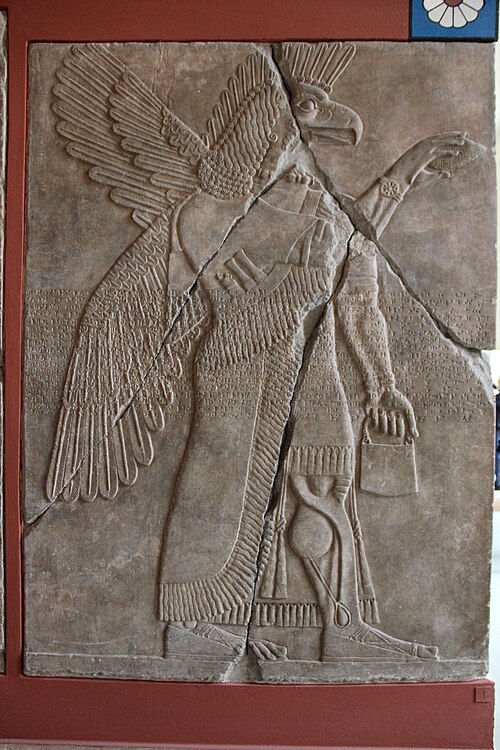
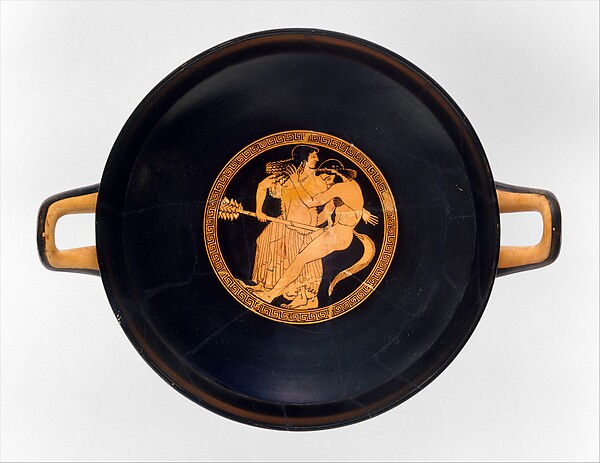
The pine cone is a very old sacred symbol in the West and the Middle East. On a relief that adorned the walls of the Assyrian palace at Nimrud nearly three thousand years ago, a winged guardian spirit (apkallu) stands holding a pine cone–shaped object in one hand and a small bucket in the other. Scholars see it as a tool for sprinkling holy water to purify the king and the sacred tree. The Greek god Dionysus and his followers carried a staff tipped like a pine cone, the “thyrsus.” The giant bronze pine cone made in Roman times, the “Pigna,” became in the Middle Ages a fountain in the forecourt of Old St. Peter’s Basilica, and now stands in a courtyard of the Vatican Museums.

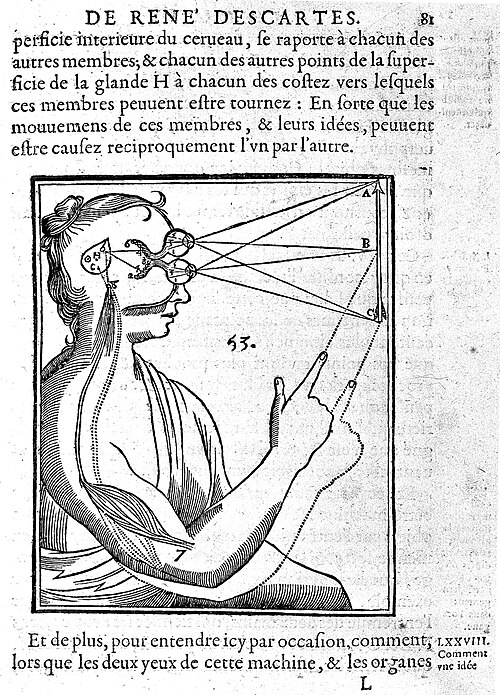
The very name of the pineal gland in the brain comes from the pine cone. In the second century Galen, a Greek physician working in Rome, called this small gland the “konarion” because it resembled a pine cone, and the Latin “pinealis” (like a pine cone) became its name today. The one who made this small pine cone–shaped gland the seat of the soul was Descartes in the seventeenth century. He said that “this gland is the principal seat of the soul, and the place in which all our thoughts are formed” (a letter to Meyssonnier of January 1640). He set out the same idea in The Passions of the Soul (1649) as well. Since the pineal gland is the one organ in the brain that is single rather than a left-and-right pair, he held that here the images coming in through the two eyes are united into one, and the soul meets the body.
The “eye of the soul” begins with Plato. In the Timaeus he called the head “the most divine part” of our body, and in the Republic he said that every person has an eye of the soul. He held that with the eye of the soul contained in the mind we can see and express the truth of the universe.
We must now use the eye of the soul to see the light of the universe that passes through all things, and turn towards eternal truth.170
He insisted that only the eye of the soul reaches truth. It is a philosophy that gives absoluteness to religious and metaphysical discoveries.
The eye of the soul is more important than ten thousand eyes of the body, for by it alone is truth seen.171
The idea that the pineal gland is a “third eye” arose much later. In 1886 the British biologist Baldwin Spencer showed that lizards and the tuatara of New Zealand have on the crown of the head a small light-sensing “third eye,” and that it shares a root with the pineal gland. Two years later the Theosophist Blavatsky, in The Secret Doctrine (1888), wove it together with the eye on the forehead of the god Shiva, and the idea that “the pineal gland is the third eye” spread widely. In fact the human pineal gland releases melatonin when it grows dark, telling the body of night and of the seasons. The little pine cone in our heads is still responding to light today.
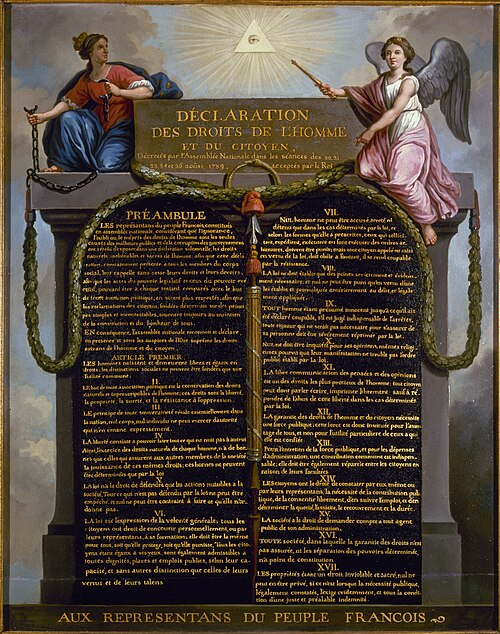
The eye of the soul reappears in the modern West as “the eye of God.” At the top of the picture of the French “Declaration of the Rights of Man and of the Citizen” that Le Barbier painted around 1789 is an eye within a shining triangle, and the same eye sits above a pyramid on the reverse of the Great Seal of the United States, adopted in 1782, and, since 1935, on the back of the one-dollar bill. It is the Christian symbol of God’s providence looking down on all things, the “Eye of Providence.”
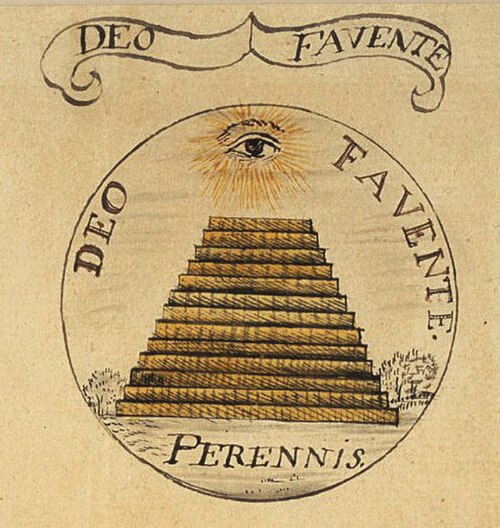
So, through the pine cone and the eye of the soul, the foundation of the thought of worshipping the human mind settled into Western civilisation over thousands of years of history. In the modern Western era, the worship of the mind takes a new form. From worshipping the mind through images such as the pine cone and the third eye, it turns to going inside the mind and expressing it. This is “metaphysics,” in which Western civilisation values a mind separated from instinct.
2) The Spread of the Civilisation of Mind Worship: From Images to Philosophical Systems
A representative example of the artificial division and explanation of human nature is the stance of explaining it by splitting it in two: instinct and mind (body and mind, passion and intellect, physiology and psychology, feeling and reason, flesh and soul). For two thousand years Western civilisation took this division for granted and tried to see the mind as an independent phenomenon set against the body. To the question of who we are, it puts forward a theory of human nature as the struggle of spirit and flesh. In antiquity Plato held that the soul aims at the world of Ideas, but the body, bound to sensual desire, hinders the soul. Medieval Christianity held that the spirit is divine and good, and the body, the source of desire and sin, stands against the spirit. In the West, God is not a god of nature but a God of justice, a good God: a product of the mind. And above all, as the doctrine of the Trinity shows well, he is a spiritual being. Human beings, made in the image of that God, are likewise treated as fundamentally spiritual and mental beings. In modern Western rationalism, Descartes argued for the importance of the mind within a dualism that divides mind and body into separate substances.
Ancient Metaphysics, Medieval Theocentrism, Modern Rationalism
In Greek civilisation before Socrates, the concept of “balance” between instinct and mind carried considerable weight. It was an age before the universalisation of the mind or any sharp separation of mind and instinct, an age of balance, in which the Apollonian and the Dionysian held each other in check. In Greek civilisation Apollo is the emblem of reason and mind; Dionysus is the emblem of the senses and instinct. Mind and instinct, the Apollonian and the Dionysian, stood opposed. Nietzsche explains this situation:
Through the two gods of Greek art, Apollo and Dionysus, we learn that in the Greek world there was a fierce opposition, in origin as in aim, between the Apollonian art of sculpture and the non-plastic, Dionysian art of music… They appeared united as one, and from this union arose an art at once Apollonian and Dionysian: Attic tragedy.172
It was the three philosophers Socrates, Plato and Aristotle who decisively broke this opposition. They argued for metaphysics: that the mind is human nature, while the body is matter and has no value. They argued that all human effort must inquire into the mind separated from the body, and through it reach eternal truth. The tradition of mind worship continued in Greek and Mediterranean civilisation, but it was they who made it into philosophy. They thought that only the Greeks had the mind or soul God gives. Their thought of soul worship they learned from Pythagoras. They also expressed the mind as the essence of human beings, which followed Parmenides’s thought that “the senses deceive, and only the mind perceives truth.” With Aristotle especially, they called the study of the mind metaphysics and valued it as the heart of philosophy. Belittling human instinct, they analysed it as the same as animal instinct. They combined Pythagoras’s thought of soul worship with Parmenides’s thought of mind worship, identified soul and mind, and exerted a decisive influence in spreading the philosophy of mind worship through Western civilisation.
For them the mind, that is, the soul, was what mattered. Aristotle in particular saw barbarians, such as the Persians, as like animals without a soul, and so argued that they should all be made slaves. The philosophy of oppositional dualism, separating instinct and mind, passed through Socrates and Plato and was completed with Aristotle. From the standpoint of the philosophy of being, he held that the differences in soul and mind between Greeks and barbarians, men and women, were eternal. He was a great philosopher, but he laid the foundations of racial and gender discrimination. Aristotle left the following words in his book the Politics:
But among barbarians no distinction is made between women and slaves, because there is no natural ruler among them: they are a community of slaves, male and female. Wherefore the poets say, “It is meet that Hellenes should rule over barbarians;” as if they thought that the barbarian and the slave were by nature one.173
The human submission to the gods, that is, human obedience to fate, that appears in pre-Socratic Greek tragedy is like the harmony between nature and humanity that appears in Eastern civilisation. And as Eastern poetry expresses the harmony of humanity and nature, Hellenistic sculpture stresses the harmony of mind and instinct. In this respect pre-Socratic Greek culture had the character of a culture of the mean, called sophrosyne. This mean, this state of balance, is found everywhere in pre-Socratic Greek culture. The Greeks had a religion, not a monotheism but a polytheism, in which many gods held each other in check and kept a balance.
In Greek myth the “gods of destiny” were three goddesses called the “Moirai” (the Fates). Even the immortal gods, Zeus included, had to obey their decrees of fate. Fate balanced the immortality of the gods. And the metaphysical stance of asserting the absoluteness of the mind, expressed by a group of the Eleatic school led by Parmenides, was held in check and balanced by the Greek way of education, which put great weight on physical training.
This Greek humanism forms the theme of Greek tragedy, whose subject is human resistance to fate and the punishment of the gods. The tragedies of Aeschylus, too, keep a balance between human resistance to fate and divine punishment, but already the wind was on the side of human resistance. This unstable balance appears with extreme tension in Socrates. Between the extreme positions of “ceaseless questioning” and “knowing nothing,” the expression of Greek humanism reaches its height. But Socrates is at once the end point of balance and the starting point of division. To ask “ceaseless questions” and always reach the conclusion that “nothing can be known” was possible only for Socrates, “the wisest.” The history of Western culture after Socrates shows us that for other human beings it was almost impossible.
Hellenistic civilisation, prying apart the harmony and unity of mind and instinct, dissecting the substance of the mental and inquiring into it without end, began the work of giving the mind absolute value. In the end it came to value knowledge above wisdom. Western civilisation after Socrates believed in the absoluteness of knowledge and immersed itself in the pursuit of knowledge rather than wisdom. As mind and instinct separated, and the Apollonian and the Dionysian separated, Greek tragedy too was destroyed:
Let us consider the significance of the Socratic maxims: “Virtue is knowledge; man sins only from ignorance; he who is virtuous is happy.” These three fundamental forms of optimism involve the death of tragedy.174
The death of Greek tragedy means the destruction of the harmony of instinct and mind that Greek civilisation had enjoyed. The destruction of the balance of instinct and mind was the work of the philosophy of Socrates, Plato and Aristotle. They are the ones who made Western civilisation abandon the unmanifest argued for by Heraclitus and others, and choose the manifest, which worships the mind. The manifest dominated the history of Western philosophy for nearly two thousand years, from Socrates through the Middle Ages to the Renaissance.
This was because Western civilisation had adopted the theories of the so-called philosophers of the manifest of Greek civilisation, named as Socrates, Plato and Aristotle, and relied on the power of religion. In Greek civilisation before Socrates there was a period of several hundred years of balance between Apollo and Dionysus. In this period the philosophy of the unmanifest, such as Heraclitus’s, was as important as the philosophy of the manifest, because Greek civilisation was aware of the importance of “balance” between mind and instinct. They stressed the mean and moderation. But already in the time of Socrates, the current of the age had turned its back on Dionysus and taken the side of Apollo.
The Western worship of reason and mind is tied above all to religion, because it connected the mind to God. Human beings bear “the image of God” (Imago Dei): “God said, ‘Let’s make man in our image, after our likeness’” (Genesis 1:26). “God is spirit” (John 4:24). It was only natural that in the West human beings, made in God’s image, were treated as fundamentally spiritual beings.
In the West the importance of the mind was stressed not only in religion but also in the philosophical field of metaphysics. Aristotle, defining metaphysics, treated it as the study of the mind as opposed to matter. He divided metaphysics, the branch of philosophy that inquires into the nature of being and reality, into several fields, such as ontology. This philosophical tendency was regarded as the most important field in medieval religion as well, and modern philosophy, too, came to stress the importance of the mind. Leibniz (1646–1716), a modern Western philosopher who had a great influence on rationalism, set out his view of the greatness of the human mind.
It is not in the least surprising that human beings can know the world. For they hold the world within themselves, and are themselves an image of God in miniature.175
This is the beginning of the rationalism in which theocentrism shifts to the human mind. With it the close relationship between God and the human mind spread still more widely in Western civilisation. For the thousand years of the Middle Ages, scholarship and writing were mostly about religion. Scholasticism is a theocentric philosophy that studied only the Bible and concentrated solely on religion. Boccaccio’s Decameron and Machiavelli’s The Prince, grounded in the humanism of the early Renaissance, became important because they were the first books to announce the transition from theocentrism to humanism. The ceiling fresco of the Sistine Chapel left by Michelangelo, the great master of the Renaissance, also includes a picture of God breathing the mind into man. Because the Roman Curia at the time strictly forbade anatomical depictions of the human body, he used the device of placing a human brain behind God, so that God is in the brain. In Michelangelo’s The Creation of Adam, c. 1510, God, set against the background of a brain, passes the mind to Adam: it stresses the importance of the mind in Western civilisation.
Western civilisation treats mental phenomena as supernatural. It believed that a supernatural God had given human beings a supernatural mind. God gave the mind to human beings alone, not to other animals. The mind stands in opposition to the body: “For those who live according to the flesh set their minds on the things of the flesh, but those who live according to the Spirit, the things of the Spirit. For the mind of the flesh is death, but the mind of the Spirit is life and peace” (Romans 8:5–6). The separation and opposition of mind and instinct was not only an important Christian doctrine but was accepted in Greco-Roman philosophy too. It is plain in the words the Roman emperor Julian (330–363) left before his death: “I have learned from philosophy how much more important the soul is than instinct. That the soul is separated at death is a cause not of pain but of joy.”176
The interpretation of human nature as mind worship took its place at the core of Western civilisation. The philosophy of mind worship began with the Greek manifest, passed through the religious age of the Middle Ages and the metaphysics of Descartes in the modern era, and entered its final stage: the age of ideology of the twentieth century. In the religious age of the Middle Ages, the West concentrated solely on the study of revealed religion, the study of the mind God gives to human beings. Medieval religious philosophy is represented by Augustine of the fourth century, who tried to graft Plato’s philosophy onto revealed religion. Scholasticism, which began in the eleventh century and is represented by Thomas Aquinas in the thirteenth, was an effort to link religion with the philosophy of Aristotle. This effort to concentrate on the mind influenced Descartes after the Renaissance, and Descartes laid the foundations of modern metaphysics, represented by rationalism. He played the role of replacing the Christian “mind” of the Middle Ages with a metaphysical “mind.”
Beyond the Christian-dominated Middle Ages and the Renaissance, the West faced a philosophical change in the seventeenth and eighteenth centuries. In this period, which we call the Enlightenment or the age of the mind, the West went through an “enlightenment” that freed it from the dogmas bound up with religion and the Bible. Rather than believing what was written in the Bible, such as geocentrism, simply as truth, people would examine it with the mind human beings have and judge whether it was true or false. This examination was spurred by the great paradigm shift in which geocentrism was replaced by heliocentrism, thanks to the development of astronomy in the West.
As some of the truths of absolute truth recorded in the Bible came under suspicion, doubts arose about the nature of God. In particular, people reached the stage of examining whether the truths, commandments and laws that the prophets delivered after meeting God really came from God or from the prophets’ imaginations. So Western thinkers established a new thought, deism (理神論): that God exists but does not intervene in human affairs. Through deism Westerners were freed from miracles, hell, Satan and the like.
The deists argued that the word of God delivered by prophets is not absolute truth, and that what the human mind judges is right. They believed that the source of knowledge is not theocentrism but reliance on the mind. By increasing faith in thought and science supported by the mind, they laid the foundations of the Industrial Revolution of the eighteenth and nineteenth centuries; they sought to form governments not by the authority of a church grounded in a covenant with God but by a new theory of human nature; and they argued for the separation of church and state. The beginning of the Enlightenment was inspired by the writings of Francis Bacon, René Descartes, Baruch Spinoza, Isaac Newton and others in the seventeenth century.
But we must note that in Western civilisation the estimation of the powers of the mind grew stronger still through the age of the mind. Analysed philosophically, two choices lay open to Western civilisation as it passed through the age of the mind. The West could follow a philosophy that argues for harmony between mind and instinct and put the power of the mind in its proper place; or it could follow a philosophy of universalising the mind, disregarding instinct still more and growing the power of the mind still further. Here the West chose the latter: the road of universalising the mind, which stresses the importance of the mind.
Because this bias towards the side of Apollo formed the foundation of Western civilisation, the period in the Renaissance when mind and instinct existed together was short, and the current already stood on the side of universalising the powers of the mind. Between Descartes and Machiavelli, who alike held a partial truth and a one-sided view between mind and instinct, Descartes was praised and Machiavelli became the target of many people’s condemnation.
The history of Western thought from Descartes to Marx, which dominated the age of the universalisation of the mind, can be schematised as follows. Descartes: I think, therefore I am (reason). Kant: I who do not think do not exist (pure reason). Hegel: a human being who does not think as I do does not exist (absolute reason). Marx: a human being who does not think as I do must be proved not to exist in political reality (praxis). All of them believed that the mind they argued for had absolute value. With Marx especially, the absolute value of his historical mind stressed its absoluteness still more by calling for the elimination of opponents.
Marx saw this world in terms of black and white, and regarded anyone who did not side with him as an enemy, without condition. He knew clearly whose side he stood on, and was sure that he would fight for them and that they would win in the end.177
From Descartes, who believed that the mind exists separately in the brain, to Kant and Hegel, who argued for a deontology of moral duty, Western philosophy was dominated by the rationalists. Under their influence a period spread in the West of mistakenly believing that what matters most in human beings is the mind, and that the mind creates everything. From the standpoint of the theory of human nature, the most important problem Western philosophers created is the enormous error that “the mind can create what is not in instinct.” This tendency the Western rationalists created ended in the tragedies of the age of ideology. In the theory of human nature there is a principle we must stress again and again, and accept: “the mind cannot create by itself what is not in instinct.”
As time went on, the Western rationalists kept distancing themselves from instinct and maximised their reliance on the powers of the mind alone: the phenomenon of “the absolutisation of the mind,” or “the absolutisation of the powers of the mind.” But as the role of the mind grows, instinct naturally rebels against the powers of the mind. Against the general tendency of Western civilisation to despise instinct and pursue only the mind, a reaction could not but arise.
Professor Paglia expresses the relationship between mind and instinct as the relationship between the anatomical brains that human beings cannot escape: the new brain and the old brain. It is a brilliant insight to express it not as “Apollo as order vs Dionysus as disorder” but as “Apollo as order vs Dionysus as energy.” Instinct is energy, the source of power, and the mind is the order that regulates energy.
The struggle between Apollo and Dionysus is the struggle in the brain between the new brain (the higher cortex) and the old brain (the older limbic and reptilian brains). In the end art is the expression of the dilemma human beings always have: the dilemma between the order expressed by Apollo and the energy expressed by Dionysus.178
From Machiavelli through Hobbes and Schopenhauer to Nietzsche, the history of Western philosophy had philosophers who were faithful to instinct rather than the mind. This current, faithful to instinct rather than to the mind as in Machiavelli, is not as distinct as the rationalist current from Descartes to Marx, but its traces can be found plentifully in Schopenhauer and Nietzsche. At the same time, whether Nietzsche intended it or not, his philosophy gave decisive theoretical support to the fascism of Mussolini and Hitler. Hitler grew fascism under influences such as Nietzsche’s. The motto of the Hitler Youth was taken from Nietzsche: “What does not kill me makes me stronger.”
Machiavelli, the forerunner of this current, committed the error of leaning too heavily on instinct in grasping human nature, just as Descartes committed the error of leaning on the mind. Machiavelli’s grave fault lies not in his being immoral but in his not giving enough weight to the moral factor in politics. Machiavelli observed human behaviour from an amoral standpoint. Human beings have a neocortex as well as a limbic system. Cesare Borgia, who killed four mercenary captains by treachery, was committing a grave political blunder.179 The history of modern Western philosophy shows a distortion of the theory of human nature centred on the mind, and at the same time, as a reaction against it, a distortion centred on instinct.
In this respect there was a time when the philosophy that saw the Western history of the mind as the development of the mind, as the metaphysicians argued, was in fashion. But this philosophy was not meant to grasp the truth; it was the claim of rationalists biased towards the mind, and it served to justify with philosophy the situation the West found itself in. It is closer to reality to grasp modern Western history not as the development of the mind but as a dialectical situation in which, while “the alienated mind” keeps the initiative, “the alienated instinct” rebels against it.
The current of alienated instinct from Machiavelli to Hitler can be schematised as follows: from Machiavelli’s justification of a life for victory alone, without morality (amoral), to Schopenhauer’s philosophy of the will to live, through Nietzsche’s will to power, and at last to Hitler’s philosophy of the strong monopolising living space (Lebensraum).
The significance of the Second World War for the history of Western thought is that the fall of fascism removed communism’s most powerful rival. Communism came to be justified and praised in some quarters, while fascism received everyone’s curse and condemnation. Picasso openly declared that his feeling towards communism was “the feeling of a thirsty animal heading for a spring,” and the postwar Western intelligentsia, dominated by Sartre and others, spent the decades after the war in a climate in which one had to pretend to be on the left to be respected, and was proud of it.180
And the means left to stand against communism, the alienated mind, are only the common sense of unalienated human beings, the mean that Western philosophers do not value, and the insight that Spinoza, Voltaire, Goethe, Lessing and others kept even amid the passion and chaos of the history of Western philosophy.
Critics of the Civilisation of Mind Worship: Voltaire, Nietzsche, Heidegger
Some thinkers pointed out starkly how serious a problem it is that Western civilisation leans towards metaphysical philosophy: Voltaire in the eighteenth century, Nietzsche in the nineteenth and Heidegger in the twentieth. Voltaire and Nietzsche pointed out the fundamental problems of theology and metaphysics, which form the backbone of the history of modern Western civilisation. Heidegger, criticising a Western philosophical system that concentrates on the mind, argued that we must concentrate on human existence itself. Going further, they did not stop at modern Western history but tried to find the cause of the problems facing Western civilisation in the Greek philosophy of Socrates and Plato, criticising their manifest. In pointing out the problems of metaphysics, these three thinkers naturally criticise Plato too, who made it the mainstream of Western philosophy. Plato, describing the mind as “the eye of the soul,” is the figure who led the civilisation of mind worship to dominate the Western philosophical system.
Their criticism reaches, through theology, metaphysics and the Greek philosophers of the manifest, the problem of human nature. Before Voltaire’s and Nietzsche’s critiques of metaphysics, of course, Spinoza had pointed out the problems of the Western rationalists, noting that instinct and mind cannot be separated; but Western civilisation led its philosophy and civilisation in the direction of valuing the powers of the mind within human nature, and came to belittle or despise instinct. Since modern history, that is, Western civilisation has ended in the problem of distorting human nature. Humanism was founded on a philosophy that distorts human nature.
Western civilisation received what concerns ethics from Christianity, and what concerns knowledge from the Greco-Roman tradition. Christianity is built on a philosophy of being that chooses separation over harmony in the relationships between humanity and nature, between human beings, and between mind and instinct. Western civilisation accepted a religion built on this philosophy, and from Greek culture, too, it took and absorbed what suited separation rather than harmony, progress rather than the mean.
In modern history the West came to revere “metaphysical truth” as if it were the God of medieval religion. This Western civilisation came to rely on a philosophy that overrates the human mind, the powers of the human mind, and is infatuated with it. The universalisation of the mind in the end set off a distortion of human nature in the theory of human nature, and the philosopher who firmly voiced his opposition to it was Voltaire.
I have concluded to reject, more than ever, all my ideas about metaphysics. I have also concluded that I am a feeble animal walking on shifting sand that keeps sinking beneath me, and that nothing would be madder than to believe oneself always right.181
Voltaire speaks as follows of the worthlessness of a metaphysics that asserts the absolute, or holds that what it asserts is always right:
At the end of almost every book of metaphysics, let us write the two words the Roman judges used when they did not agree: “Non liquet,” it is not clear.182
Feuerbach, too, expresses the same view of metaphysics. He pointed out in particular that what metaphysics and theology have in common is the manifest: that human beings can express the absolute and firmly believe it as truth. He said that “whoever does not give up Hegel’s philosophy does not give up theology.”183 In this respect the metaphysicians, in pursuing the manifest, remained on the same level as theology and can be seen as having hindered the development of a true philosophy. Comte, the founder of positivism, gave the same diagnosis:
Metaphysics is in the end nothing but a kind of theology, gradually enervated by dissolving simplifications.184
In the end, post-Renaissance Western metaphysics, in which human beings express the absolute and believe it, can be seen in its broad current as a continuation of medieval theology. These theological metaphysicians, pursuing metaphysical truth, held up a utopia and tried to drive human beings towards it:
The Germans found an expedient for recovering the old “ideal” and reuniting the “ideal” with truth. But this was in the end nothing but a means of justifying the right to reject science and the right to lie. Leibniz and Kant! These are the two men who most distorted the intellectual integrity of the West.185
Pointing at this, Nietzsche declared that “both Leibniz and Kant” can be seen as “theologians wearing the shell of metaphysics”:
Kant’s success is merely a theologian’s success. Kant, following Luther and following Leibniz, played the role of a brake on progress: one more clog keeping time with the discordant beat of German rigidity.186
Absorbed in seeking a truth that cannot be reached through theology or metaphysics, they kept suppressing the ordinary joys of life, and made life dark and bleak by holding up only duties whose beneficiary and purpose were unclear. The city of God Calvin founded in Geneva, the Protestant society Luther pictured, the world Cromwell briefly realised in England: none is much different from a society in which the moral law Kant conceived is realised.
What destroys a man more quickly than to work, think and feel without inner necessity, without any deep personal choice, without pleasure, as a mere automaton of duty? That is the recipe for decadence, and no less for idiocy… Kant chose idiocy for himself. And such a man was the contemporary of Goethe!187
This negative attitude of Western civilisation towards life agrees fundamentally with the attitude that appears in the Christian doctrine of original sin. It is only natural that such Christian doctrine was strongly influenced by Socrates and Plato, who, among Greek philosophers, did not value the joy of life. Acknowledging the joy of life is one of the important characteristics of Eastern civilisation. On this point it differs greatly from the Buddhism of India, too.
Indian Buddhism starts from the proposition that “life is suffering.” Both of these ignore or forget the joy in life that Eastern civilisation expresses. But for human beings, “the natural order of life (生理) is the root; the perverse (怪理) or the pathological (病理) cannot be the root.”188 If Eastern philosophy took the natural order of life (life as joy) as its root, Western philosophy can be said to have taken the perverse (life as sin), and Indian philosophy the pathological (life as suffering).
In the Analects, in the chapter “Xian Jin” (先進), the “joy of life,” valued above military victory, political achievement or ancestor worship, of “in late spring, when the spring clothes are ready, going with five or six grown men and six or seven boys to bathe in the Yi (沂水), enjoy the breeze at the rain altar (舞雩), and come home singing”189 has vanished without a trace from Western civilisation. The Analects, most valued in Confucianism, begins its first sentence with an expression of “the joy of life”: “Is it not a joy to have friends come from afar?” Confucius sums up, “Those who know it are not as good as those who love it, and those who love it are not as good as those who delight in it,”190 and “values the capacity to enjoy life above knowledge.”
The tendency to replace the joy of life with a passion for duty stands out in medieval Western Christianity and modern metaphysics. But the root of this tendency can be found in the manifest of Greek civilisation after Socrates. The Socrates Plato portrays “makes one angry and exasperated.” The logic is orderly and the expression grand and elegant, but, as Voltaire put it, when one comes to one’s senses “at the first cock-crow, when the phantoms vanish,” there are countless absurd sophistries. In the “Apology of Socrates” Plato paints the moving end of Socrates. But strip away the flowery phrases and strange expressions that all the sages of China, Laozi and Confucius first among them, warned against and rejected, sum up the gist, and Plato’s philosophy of death and life can be put like this: “Death is either no more than a long sleep, or it is connected to an afterlife. So a long sleep is a good thing, and going to the afterlife to meet the wise men of old who have arrived before us and carry on a pleasant conversation is also a good thing. Therefore no one knows which is better, life or death.” That is about it. What an enormous sophistry!
Where has all the joy of life gone? If Socrates thought death so pleasant or so good, should he not be indifferent, or grateful, when others kill him? In fact Socrates seems to have accepted death calmly. When his wife Xanthippe protested, “That you should die so unjustly!” Socrates is said to have retorted, or consoled her: “Would you rather I were put to death justly?” Plato says nothing whatever about the joy of life, and gives no thought at all to the sorrow of losing that joy through death.
Even in the pre-Socratic Greek myth of Sisyphus, Sisyphus’s attachment to the joy of life, so intense that he deceived even Hades, king of the underworld, has been forgotten, and only the image of Sisyphus defying the fate of rolling his stone uphill is revered in Western civilisation as the image of a hero. Socrates may be the steadfast man who founded the optimism that infinite progress is possible for human beings. But if progress is only a fiction, he may be a sophist who did away with “the instinctive joy of life” in the name of progress. By insisting that only knowledge has value and everything else, the joy of life included, has none, Plato passed on to Western civilisation a philosophy that values metaphysical duty above all.
The joy the East feels in life comes from a theory of human nature entirely different from the rapture that comes from worshipping a religious absolute or submitting to a metaphysical absolute. The Eastern theory of human nature starts from acknowledging the unity of instinct and mind; the Western theory starts from disregarding instinct and acknowledging the superiority of the mind. These theories of human nature become the starting points of naturalism and supernaturalism. To destroy the balance or harmony of instinct and mind and assert the superiority of the mind becomes the foundation of the manifest, and goes together with the supernatural. Voltaire, who fought against the many superstitions and dogmas that borrowed the name of religion, thought that the manifest attributes of God were made by Westerners because they needed them, and could never have been revealed or commanded to human beings by God.
According to Voltaire, Westerners distort the attributes of God to suit their own needs, use them as they please, and even make God work miracles to persuade others. Is it not the greatest blasphemy to make the God who created all things and established their order break that order himself and work miracles?
Why should God work miracles? If he did so to carry out what he intended for a few human beings, God would be saying: I cannot achieve part of my intention by the creation of the universe, by all my order of the universe, or by my eternal laws. So I must change part of my eternal laws and my thoughts to carry out what cannot be done by them. Such words show not God’s power but his impotence, and an unimaginable self-contradiction. So to dare to imagine God working miracles is itself to commit sacrilege (if man can insult God). It is like saying to God, “You are a weak and inconsistent being.” To believe in miracles is therefore foolish, and irreverent towards God.191
Hegel, in his eagerness to justify such miracles, sets forth in his famous philosophy of history the absurd argument that “miracles are extremely relative, and the phenomena a magnet displays are also among the miracles.”192 As said before, a God who works miracles can only be a being that transcends nature. And human beings made in his image, identifying themselves with that God, go through a process of being cut off from nature and transformed into supernatural beings too.
“Know thyself,” the saying Socrates made popular, is an expression telling us to turn our eyes to our inner world, and through the metaphysical stance of Plato and Aristotle it was transformed into the claim that we can know our own essence. The attitude that truth can be grasped and the absolute can be known is the heart of the manifest. This attitude of the manifest shows clearly in the philosophical attitude of Socrates as Plato portrays him.
This is why Lessing, the most honest of theorists, dared to say that he would put more weight on the search for truth than on truth itself. With these words he astonished and angered all the pedants, but he laid bare the deep secret of science. Beside this rare confession, an utterly honest one, there stands the deep-rooted illusion that first appears in Socrates: the unshakable belief that the powers of the mind, on the basis of causality, can reach down to the roots of human existence, and not only know them but even correct them. This sublime metaphysical illusion clings to science like an instinct and leads it on ceaselessly, until it turns into art. Herein lies the purpose of this mechanism.193
But when the maxim “know thyself” is linked to metaphysics, it leads to the conclusion of asserting absolutely the truth one has discovered oneself. The attitude of claiming that one can know, and has discovered, an essence that cannot be known leads to the manifest, the essence of theology and metaphysics. But no one except God knows his own essence. This is Voltaire’s claim:
It would be a fine thing to see one’s own soul. “Know thyself” is an excellent maxim, but only God can put it into practice. Who but God can know his own essence? We call soul that which animates us. Thanks to the limits of our intelligence, we know nothing more of it. Three quarters of humankind are content with that, and are no longer troubled at being thinking beings. The remaining quarter seek to know it. But no one has found it, and no one ever will.194
The German philosopher Theodor Lessing (1872–1933) described the human being within this European civilisation as “a species of carnivorous ape that has gradually grown megalomaniac about its so-called mind.”195 In a European civilisation overwhelmed by this mental element, the Apollonian, to borrow Nietzsche’s term, only a whole man (全人) like Goethe, who grasped the whole, could cry out, “Is not the core of nature the human heart?”196
Homo sapiens has, besides the physiological wants and needs found in all other species, especially developed wants and needs for cultural and social life. This is the human characteristic. Calling the human being a social animal refers to precisely this. But the expression calls for special care. The human being is a “social animal,” not a “social” animal, nor a social “animal.”
The phenomenon of “the universalisation of the powers of the mind” has kept, as metaphysics, a complementary relationship with Western science as its theory and foundation. But as Western science, which asserted the absolute, that is, the classical physics of the manifest, came into confrontation with the modern physics of the unmanifest, the philosophies on which theology and metaphysics had relied for some two thousand years, Euclidean geometry and Newton’s mechanics, reached their limits. Einstein says that the scientific truths Westerners believed in as they believed in God cannot be absolute, and that to believe what human beings have discovered to be absolute is a delusion.
The concept “true” does not tally with the assertions of pure geometry, because by the word “true” we are eventually in the habit of designating always the correspondence with a “real” object; geometry, however, is not concerned with the relation of the ideas involved in it to objects of experience, but only with the logical connection of these ideas among themselves.197
Yet despite this decisive development, which brought about a paradigm shift in science, Western philosophy has not broken free of its historic tendency to worship God and the mind. As modern metaphysics succeeded medieval theology, Protestantism succeeded Catholicism. Luther inherited and rebuilt the historic tradition of Christianity.
Luther, that fatal monk, restored the church. But what is far worse, he restored Christianity at the very moment it was about to vanish.198
That Western civilisation cannot break out of the bounds of the manifest is because of its tradition. Because for 2,500 years since Socrates Western civilisation kept away from the unmanifest and was absorbed in the manifest alone, it finds it very hard to break free of the manifest traditions of religion, metaphysics and ideology. Their manifest destroyed the balance between mind and instinct and made the current that values the mind alone a core element of Western civilisation.
It became possible for Westerners to recognise the destruction of the balance of mind and instinct, and the problems of a metaphysics that worships the mind, only in the modern era. Nietzsche’s philosophy above all clearly expresses opposition to Socrates’s mind-centred philosophy and to metaphysics. The German philosopher Heidegger, pointing out that Western civilisation is a mind-centred civilisation, pointed to the need to concentrate on “being itself, beyond the mind.” From the standpoint of human nature, human being itself includes both instinct and mind. Heidegger sharply pointed out the one-sidedness of a Western history of thought concentrated on the mind. A philosophy that would concentrate not on the mind but on the whole of human being, instinct included, runs in the same vein as the Eastern philosophical system that connects mind and instinct.
Heidegger criticised Plato’s philosophy for its bias towards the powers of the mind. He saw the metaphysics that began with Plato, Aristotle and others as the problem, and judged it the cause that set Western civilisation on the path of distorting truth. Because this distortion of Western civilisation has continued from the Greek period through medieval religion to the modern and contemporary eras, he held that the whole tradition of Western philosophy must in the end be fundamentally re-examined. Plato’s theory of Ideas in the end subordinated being to the Ideas and made it metaphysical, and as this philosophical view joined forces with revealed religion it led Western civilisation for more than two thousand years. In the twentieth century above all, as metaphysics was maximised, ideologies biased towards the mind, or towards the instinct that opposes the mind, came for a time to rule the world: the former, biased towards the mind, was communism; the latter, following instinct, fascism. The ideologies of the twentieth century made a practice of destroying human character itself, represented by ethics, for the sake of realising ideals that could not be realised.
Pointing at the mind-centred philosophy of the West, Heidegger held that it had lost not the human mind but the thinking of being, the ability to see the human being as a whole. He saw Descartes’s proposition, “I think, therefore I am,” as the starting point of the metaphysical, mind-centred thought of the West. Following his philosophy, for a human being centred on “being itself, beyond the mind,” it should be “I am, therefore I think.” Heidegger argued that in the comparative philosophy of mind and being, we must learn anew a way of thinking centred on being. He criticised Western rationalism as a thinking that has forgotten being.
At the level of culture, Greek culture lost its insight and perished first of all because, as the example of Socrates shows, it brought about the maximisation of the mind. The maximisation of the mind means the destruction of the harmony and balance between mind and instinct, and the destruction of insight. Just as the cause of Athens’s fall was rejecting Pericles’s dying counsel of moderation and launching the reckless Sicilian expedition, the cause of the destruction of Greek balance lies in breaking the wisdom carved on the sign of the temple at Delphi, to keep to the mean, and entering the road of universalising the powers of the mind. Socrates must be seen as the one responsible.
Socrates and his successors, by continuing to reason through the dialectic of knowledge, made even the highest moral compassion, devotion, heroic action and constancy of mind (恒心), so hard to attain, which the Apollonian Greeks called the mean, seem as though they could be taught.199
Confucius declared: “How great is the power of the mean! Yet it is rare for people to keep to it for long.”200 Eastern civilisation, which kept its distance from theology and metaphysics, was able to keep to the mean. Christian theology, and the Greek metaphysics developed by Plato and Aristotle, have for more than two thousand years led Westerners to claim that they can know the unknowable essence of humanity or of nature. This metaphysical tendency exerted great power while the West was active in an “open world,” conquering the world, for nearly 450 years, from the sixteenth century to the mid-twentieth, which we call the Atlantic age. But as the conquest of the world is complete and the open world comes to an end, the role of metaphysics is coming to an end too.
A phenomenon that arises at the same time as the universalisation of mental phenomena is an attachment to causality. Causality is denied in Eastern civilisation, which argues for the philosophy of change, but in the West it is an indispensable cornerstone of the idea of progress, which justifies the universalisation of mental phenomena. A philosophy flourishes in which human beings advance gradually towards absolute truth. Causality, given firm expression by Plato and Aristotle, was vigorously revived by Leibniz after the Renaissance and helped keep the culture of progress alive. And, as we saw in Darwin’s theory of evolution, it also played a part in enabling Darwin to argue for “gradual” evolution. Voltaire sharply criticised the fictitiousness of this Western culture.
When I first read Plato, I was much moved to see all living things arranged in steps, from the lightest atom to the supreme being. But when I looked closely, the great phantom vanished, as the ghosts of old vanished at the first cock-crow.201
Pericles, who may be called the last Greek in that he not only understood the mean in a declining Greek society but put it into practice, brought the Athenians back to the path of the mean whenever they set out on an extreme course.
When the Athenians grew untimely arrogant and bold, Pericles frightened them; when they were afraid without reason, he restored their confidence.202
At the very time when both the Delphic motto that stands for wisdom and the mean of Pericles were disappearing, that is, as Athens was declining, Plato and Aristotle spread the philosophical world of the manifest, which would have an overwhelming influence on the West for some two thousand years thereafter, and that philosophical world came to lead Western civilisation. It went on changing, taking the forms of medieval theology and early modern and modern metaphysics.
Did not the Greeks, in their age of weakness and decline, become optimistic, superficial and rhetorical, seek logic, and try to interpret the world rationally? That is, did they not become more “sober” and “scientific”? Despite all modern ideas and democratic prejudices, who knows whether optimism, and its modern expression, the triumph of democracy, are not all symptoms of weakening, of old age and physiological fatigue?203
Even science, which above all has made astonishing progress over the last few hundred years, is, unlike what Westerners so believed, no longer certain to give humanity a bright future, now that the open world armed with the manifest has come to an end. What is the essence of science, and what effect will science have on humanity’s future?
And science itself, our science, ay, what is the significance of all science, viewed as a symptom of life? For what, worse still, whence, all science? Is the scientific spirit perhaps only fear and evasion of pessimism? A subtle defence against truth? Morally speaking, something like falsehood and cowardice? And, unmorally speaking, an artifice? O Socrates, Socrates, was this perhaps thy secret? O mysterious ironist, was this perhaps thine irony?204
Most Western philosophers push their questions forward, and when they think they have discovered something, they set it up as absolute. The manifest and the philosophy of progress are linked, because that is how “progress” goes on being justified in an open society. But if in fact “absolute truth” lies beyond the reach of human hands, then perhaps, as Lessing declared, human beings must “value the path of seeking truth more than truth itself.” If this is the human condition, then, as Confucius said, “to say you know what you know and that you do not know what you do not know” is the limit of the knowledge human beings can have. If we accept the Daoist philosophy that “life has an end, but knowledge has none,” the choice of the powers of the mind by a Western civilisation that asserts metaphysics can be seen as reaching its limits and in the end walking the road of decline.
3) The Fall of the Civilisation of Mind Worship: Ideology, the Collusion of Mind and Science
The Western thought of mind worship, racing endlessly forward, entered the road of decline in the twentieth century. The mind, armed with “rationalism,” colluded with “scientific” Social Darwinism and created the age of ideology. But ideology, grounded in a mistaken theory of human nature, set the Western world of thought on the road to ruin. The collusion of mind and science was realised in the West. The mind cannot act apart from instinct, but Western rationalism misjudged that it could, and the untested idea of Social Darwinism’s gradualism and struggle spread through the twentieth-century Western world as science. The essence of ideology is the joining of a separated mind with a false science.
Darwin argued for a theory of evolution in which human beings were not a special creation of God, but he was convinced that the creation of nature, early life included, was by God. So Darwin argued that his religious beliefs and the theory of evolution could run side by side, explaining that his faith in God was unchanged:
There is grandeur in this view of life, with its several powers, having been originally breathed by the Creator into a few forms or into one; and that, whilst this planet has gone cycling on according to the fixed law of gravity, from so simple a beginning endless forms most beautiful and most wonderful have been, and are being evolved.205
Darwin’s theory of evolution became in the end a combination of “God’s creation and nature’s evolution.” It is not a thoroughly naturalistic theory of evolution but a theory in which God’s creation and nature’s evolution coexist. Like many Western thinkers, including the deists of the Enlightenment, they could not transform Western thought entirely into naturalism, and took the approach of letting God and nature coexist. Darwin, too, offered a great idea, but his philosophical system carried on Western philosophical thought unchanged. That is how strongly the manifest tendencies of Greco-Roman times and the thoroughgoing manifest of medieval religion still worked in their thought.
Social Darwinism: “Nature Does Not Make Leaps,” “The War of All Against All”
Social Darwinism started from Darwinism, but, contrary to Darwin’s expectations, it played a decisive role in opening the age of ideology. Darwinism is the claim that human beings and the living things of the earth were not each made by God, but were made in nature through evolution: a revolutionary theory that destroys creationism, the core of the dogma of revealed religion. Darwin’s theory of evolution was published in 1859.
The problem is not Darwin’s theory of evolution itself but the Social Darwinism derived from it. Social Darwinism played a scientific role in producing the collusion of philosophy and science needed to maximise the power of the mind. If one adopts the idea that “a great discovery is the discoverer’s effort, and the problems it contains are the problems of its age,” the theory of evolution is Darwin’s great achievement. But that Darwin used, unchanged in his theory of evolution, the doctrines of struggle and gradualism deeply embedded in Western thought was the mistake of mistakes.
The theory of evolution was established within the Western system of thought. As a result, propositions that everyone in the philosophical system of the modern West accepted as self-evident scientific truths were used as the mechanism explaining Darwin’s theory of evolution. These propositions combined with the civilisation of mind worship then sweeping Western philosophy to create Social Darwinism. The mechanisms are two: “Nature does not make leaps” (Natura non facit saltum) and “the war of all against all” (Bellum omnium contra omnes). Many thinkers of the time liked to use Latin expressions to strengthen the authority of such propositions.
Social Darwinism was created by mistakenly believing that Darwin’s theory of evolution would bring about gradual, combative evolution in human history.206 With it, it plunged Western human affairs into the age of ideology.
Spencer (1820–1903), the founder of social evolutionism, argued that the survival of the fittest and natural selection apply unchanged to human society. Since society, like nature, develops through competition, he put forward the idea that “artificially helping the incompetent hinders the development of society.”
The ideologies that absorbed these claims made active use of Social Darwinism to justify inequality, racism and imperialism. Above all, the idea that human nature can “evolve” made possible policies that wiped out all ethics and humanism. The gradualism and struggle of Social Darwinism were used as “science” in communism, Nazism, racism and eugenics. Using the substitute terms survival of the fittest and natural selection for gradualism and struggle, they sought to extend their scientific character. After the terrible mistakes of the twentieth century, this Social Darwinism was shown to be mistaken thinking, because it goes against human nature. It is now discarded.
The philosophy of gradualism and struggle was foreshadowed from the very beginning of Darwin’s theory of evolution. Darwin cited in his theory, unchanged, the Western philosophy that all change happens “gradually”: “nature does not make leaps.” This maxim was the cornerstone of the thinking of nineteenth-century Western philosophy and science. Together with it, the doctrine of struggle became the core of Darwin’s theory of evolution. Darwin later borrowed Spencer’s phrase and called it the survival of the fittest. Gradualism and struggle, the core philosophy of Darwin’s theory, caused many problems. Darwin’s theory of evolution was in the end corrupted into Social Darwinism, and contributed to creating the cruel and merciless “Age of Ideology,” in which human ethics could be violated for the sake of realising a utopia.
Some thinkers, however, voiced opposition to using the then-fashionable gradualism and struggle unchanged in the theory of evolution in this way. Huxley, who came forward to defend Darwin’s theory, wrote to Darwin before the publication of On the Origin of Species pointing out the problem of Darwin’s using gradualism unchanged in the theory of evolution.
I am prepared to go to the stake if requisite in support of your theory. I am sharpening up my claws and beak in readiness. But you have loaded yourself with an unnecessary difficulty in adopting “Natura non facit saltum” so unreservedly.207
But the gradual character of Darwin’s theory of evolution is one powerful current underlying Western culture. Lamarck’s theory of evolution, the “theory of use and disuse,” which Darwin cites in On the Origin of Species, was also gradual in character. The saying “nature does not make leaps,” which Darwin liked to repeat to stress the gradualness of evolution, was in turn a concept widely accepted by scientists and philosophers. Darwin himself stresses it in On the Origin of Species:
As natural selection acts solely by accumulating slight, successive, favourable variations, it can produce no great or sudden modifications; it can act only by short and slow steps. Hence the canon of “Natura non facit saltum,” which every fresh addition to our knowledge tends to confirm, is on this theory intelligible.208
Leibniz, known for popularising the saying “nature does not make leaps,” says the following in his New Essays on Human Understanding:
Nothing takes place suddenly, and it is one of my great maxims, and among the most verified, that nature makes no leaps.209
Because of gradualism and struggle, those who argued for Social Darwinism held that human nature can evolve: that it is evolving within a human lifetime, or from generation to generation. Darwin and the other evolutionists believed that humanity has kept evolving since it appeared, and Comte, Marx, Hitler and others started from this theory of evolution or were decisively influenced by it.
Darwin’s theory of natural selection, in which evolution happens gradually and through struggle, may be no more than a simple error in the natural sciences. But the Social Darwinism that arises when Darwin’s theory of evolution leaves the natural sciences and is applied to the social sciences is not a simple error but a great tragedy, as in Hitler’s racist eugenics. Darwin’s writings and Hitler’s show a startling resemblance. Hitler wrote in his book Mein Kampf:
This recognition places on the state the duty, in accordance with the eternal and unchanging laws that rule the universe, to foster the best and strongest and to suppress the bad and the weak.210
Darwin concludes the part on “instinct,” chapter 8 of On the Origin of Species, as follows:
Finally, it may not be a logical deduction, but to my imagination it is far more satisfactory to look at such instincts not as specially endowed or created instincts, but as small consequences of one general law, leading to the advancement of all organic beings, namely, multiply, vary, let the strongest live and the weakest die.211
Just as Hitler’s fascism depended heavily on Darwin’s theory of evolution, communism, too, sought to believe in and rely on the theory of “the war of all against all” expressed in Darwinism as scientific truth. Marx showed a persistent and powerful curiosity about Darwin’s theory of evolution, and sent an excited letter to Engels, his alter ego.
It is remarkable how Darwin rediscovers, among beasts and plants, his English society with its division of labour, competition, opening up of new markets, ‘inventions’ and Malthusian ‘struggle for existence.’ It is Hobbes’s war of all against all.212
Marx, who wanted his system of ideas to be regarded as scientific, sought in Darwinism scientific evidence to support his communism. In a letter to Lassalle in 1861, Marx reveals this intention plainly.
Darwin’s work is most important and suits my purpose in that it provides a basis in natural science for the historical class struggle.213
The union of ideology and Social Darwinism is due above all to Darwin’s account of evolution as combative and gradual. The ideologies sought to use Darwinism as the “truth” behind their struggle and gradual change. In On the Origin of Species Darwin stresses again and again that new species arise through “gradual and combative” natural selection.
It may be said that natural selection is daily and hourly scrutinising, throughout the world, every variation, even the slightest; rejecting that which is bad, preserving and adding up all that is good.214
The combative character of Darwin’s theory of natural selection, as he himself wrote, took its hint from Malthus’s Essay on the Principle of Population.
In the next chapter the Struggle for Existence amongst all organic beings throughout the world, which inevitably follows from their high geometrical powers of increase, will be treated of. This is the doctrine of Malthus applied to the whole animal and vegetable kingdoms.215
These views of Malthus and Darwin can be seen as repeating and stressing a characteristic underlying Western culture, which sees survival as struggle, as in Machiavelli’s The Prince or Hobbes’s Leviathan. Machiavelli, who justified every means for survival and victory without regard to morality (amoral); Hobbes, who saw “the war of all against all” as the state of nature;216 Malthus, who applied the struggle for existence to human society and the natural world; and Darwin with his theory of evolution: all stand within the current of Western culture.
Against the view of most naturalists of the time, grounded in creationism, that “each species has been independently created” and is immutable,217 Darwin argued for a mechanical, linear, reactive theory of evolution in which species were formed by “slow, slight, successive” modifications.218 By arguing that human nature evolves from moment to moment, Darwin supplied the myth of evolution and progress to the ideological movements of the nineteenth century. Social Darwinism, which contributed absolutely to creating the age of ideology in the twentieth century, was thus directly influenced by Darwin’s theory of evolution.
Man can and does select the variations given to him by nature, and thus accumulate them in any desired manner. He thus adapts animals and plants for his own benefit or pleasure.219
Darwin assumed that this gradual accumulation is selected, in nature, only for the good of the organism, and in human hands only for human beings’ own benefit. He argued that it follows the law of nature and of humanity called the survival of the fittest.
Man selects only for his own good; Nature only for that of the being which she tends.220
Can human beings invoke nature’s principle of the survival of the fittest? Darwin thought it could be amply proved. Social Darwinism became the ground for claiming that the principle of the survival of the fittest, at work in the evolution of nature, could be used by human beings and applied among human beings in human society.
Can the principle of selection, which we have seen is so potent in the hands of man, apply in nature? I think we shall see that it can act most effectually.221
This way of grasping human nature is the opposite of the theory of human nature of being that appeared in revealed religion, which held that innate human character does not change. Darwin’s theory of evolution claims that human nature is going through a process of evolving every moment. It differs from the Eastern theory of human nature of change, too. The East holds that human beings are born with the same human nature, but that after birth human character changes within the bounds of the nature they were born with. The Eastern theory, in which the mind cannot go beyond the limits of the nature all human beings are born with, but works within those limits, differs fundamentally from the theory of human nature of Darwin and Social Darwinism.
Gradualness and struggle are indispensable features of progress and evolution. They pervaded post-Renaissance Western science and philosophy, formed around determinism and causality, denying relativity and autonomy. And Darwin followed them. Darwin could not reject the prejudices Western philosophy believed in as firmly as iron: “nature does not make leaps” and “the war of all against all.” The gradual and combative character of Darwin’s theory of evolution can therefore be seen not as a new theory but as something inherent in the Western culture of the time.
Darwin’s Theory of Evolution vs Punctuated Equilibrium
The gradual theory of evolution Darwin argued for, the theory that everything is always evolving, gradually began to be shaken scientifically. The main reason is that most of the fossil record shows not gradual change but species that stay almost unchanged for a long time, with new species appearing in short periods. The missing links are the hypothesis that there were species a creature must have passed through in the course of gradual evolution, but no trace of them has been found. If such traces continue not to be found, a revision of Darwin’s theory is unavoidable. One such revised theory is “punctuated equilibrium.” According to this theory, published by Professors Eldredge and Gould in 1972, species go through long periods of stability and then diverge rapidly in short periods. Apart from such times, humanity has shown “non-evolutionary adaptation” since its evolution into Homo sapiens.
Punctuated equilibrium differs from the creationism in which God made human beings out of clay. It also differs from Darwin’s theory that all living things, human beings included, keep evolving gradually. But the theory of non-evolutionary human adaptation fits well with the philosophy of change stressed in the civilisation of the Dao. The colour of skin or eyes, the shape of nose or lips, are the features of each race that makes up modern humanity. Western scholars, for convenience, once classified modern humanity into the yellow race (Asia), the white race (the West), the black race (Africa), the brown race (India) and the red race (the Americas), claiming that they were different races. But now it is accepted that they are all the same race, and that racial features have only changed; human beings have not evolved.
The final change into Homo sapiens seems to have taken place in many places at once. From the gene pool of early Homo sapiens, the genes of modern humanity grew up at many points on the earth, and the modern humanity that shared them came to cover the earth. All the races in every part of the world today are subspecies (亞種) belonging to one species, Homo sapiens. The differences between races come from geographical isolation and adaptation to differences of climate, and are merely differences within one species (種).222
What does it mean that we have the body of Homo sapiens, and the “physical features” of a differentiated race? Are physical features, the differences in skin colour, eye colour, the shape of the nose, a process in which the body of Homo sapiens itself is evolving? Or should they be seen as simple changes unrelated to evolution, as a chameleon’s skin changes colour with its surroundings? Here the Western civilisation of God, grounded in creationism, sought until the first half of the twentieth century to regard the physical features of humanity as features of human beings created differently. On this there was no difference even after Darwin’s theory of evolution in the late nineteenth century. That is, even granting that human beings were not created as they are now but evolved to become so, they sought to treat them as different, as having evolved into different human beings.
As we saw earlier, the evolutionists believed that Homo sapiens has kept evolving since it appeared. But as the idea of progress that swept the nineteenth-century West like a fever ebbed, theories of evolution too began to change. The idea that human society keeps evolving also changed, as the evolutionists’ claim that the biological species called human keeps changing was broken.
According to the evidence of the fossil record, there is no evidence whatever that the volume or structure of the brain has changed since Homo sapiens appeared.223
At the frontier of the evolution of the species, the brain has been in an unchanging state for one to two hundred thousand years.224
If we accept this view, that Homo sapiens has not been evolving since it appeared, then evolution cannot happen “gradually,” as Darwin argued; we must see it as happening suddenly, by the very “leaps” he so struggled to deny. The missing links he spoke of must be not links that exist but have not been found, but links that simply do not exist. We must see the human brain as having grown not gradually but suddenly, by leaps, within a relatively short time, and as not having changed since. The theory of the evolution of the human brain is explained as follows.
Human beings did not evolve by the brain growing gradually in each generation; rather, species with small brains were replaced, in a punctuated way, by species with large brains.225
In fact, active fossil excavation since Darwin has turned up fossils of intermediate stages such as Archaeopteryx and Tiktaalik, but most of the fossil record does not show gradual change. The evidence of geology and paleontology denies Darwin’s gradual evolution. Accepting this physical evidence as fact, a new theory of evolution different from Darwin’s gradualism was published: punctuated equilibrium. It is groundbreaking enough to overturn every ideology grounded in the nineteenth-century theory of evolution and the idea of progress, because Social Darwinism loses its ground.226
The gist of punctuated equilibrium is explained as follows: species do not change gradually; in geological time they appear almost instantly and persist for millions of years with hardly any change.227 The paleontological evidence so far shows two features: the stability of existing species and the sudden appearance of new ones. In the change and evolution of species, the stability of existing species is shown by the near-identity of a species’ early and late fossils, and sudden appearance by new species appearing in finished form rather than through the accumulation of small changes.228 According to the evidence the fossils show, new species appear suddenly, and when they vanish they vanish suddenly.229 Evolution generally takes place in an isolated part, and a species rarely evolves by changing slowly and continuously.230
Why, of all things, must the theory of selection be tied to an unnecessary and probably mistaken hypothesis? The fossils known to us do not support the concept of gradual evolution. A group of animals dies out within a very short period, and new species always appear suddenly. No fossil evidence shows intermediate connecting species. Turn over every old stone in the same region, and there is no such fossil evidence.231
In Darwin’s theory of evolution the gradual character is inseparable from the combative character. So as long as the gradual character is revised, the combative character must be revised too. The animal world as Darwin and his followers in the nineteenth century conceived it was a cruel one, a world in which every animal devoted every minute and second to the struggle for existence. The measure of success was how many fights one had won, how many enemies one had subdued. But today it is becoming clear that fights between animals are in fact often not struggles to the death but only rituals, and that symbiosis and cooperation are as important a part of life and evolution as the struggle of life and death.232 The struggle for existence does not have as great a meaning in evolution as Darwin thought. Punctuated equilibrium denies the importance of the struggle for existence.
The individuals of the same species compete with one another only within the range of variation they were born with when the species appeared. So the struggle for existence between individuals has almost no evolutionary value and means little.233
Darwin himself wrote in On the Origin of Species that the way to prove his theory of natural selection right is the same as the way to prove the wave theory of light right.234 But as we know, since Einstein proved in 1905, through the photoelectric effect, that light also has the properties of a particle, it has become the accepted view that light has both the properties of a wave and of a particle.235 And it is interesting that Darwin himself admitted that the facts of geology and paleontology do not bear out gradual evolution, and wrote that these facts could become a challenge to his theory of natural selection, and that today this has actually happened.
Geology assuredly does not reveal any such finely graduated organic chain; and this, perhaps, is the most obvious and gravest objection which can be urged against my theory.236
Just as the mechanics of Galileo and Newton, which raged until the nineteenth century and dominated not only physics but philosophy, lost its absoluteness in the twentieth century and was embraced by Einstein’s theory of relativity, the time has come when Darwin’s theory of evolution, too, must be embraced by a more comprehensive theory of evolution such as the “punctuated equilibrium” Professor Gould argues for. The Western system of thought has lost in an instant not only its physical but also its biological foundations. The idea of progress has lost its support and become a castle in the air.
But the refutation of the theory of evolution Darwin argued for does not, of course, deny the fact of evolution he revealed. Darwin’s scholarly achievement lies in breaking the dogma of revealed religion that every single species was created, and establishing as an unchangeable fact that species arose through evolution. Darwin was a man with the courage and insight not to bend his convictions even when mocked by the prejudiced people of his time. As the saying goes, the strengths of a great idea belong to the individual and its weaknesses to the influence of the age: Darwin surely left the great achievement of showing that human beings are evolutionary beings. But it is also surely true that, influenced by his age, he committed the errors of his age in explaining the fact of evolution.
With Darwin’s theory of evolution, one can no longer argue the kind of creationism in which every flower was specially made for its corresponding insect. In this respect the theory of evolution conflicts with traditional creationism; there can be no dispute about this. But there is no denying that the core question of chance remains unsolved. There is no difference at all in the fact that life develops within an orderly universe and evolved higher organisms appear. To think that this is by chance has come to be regarded as still a foolish delusion.237
Depending on how it is interpreted, Darwin’s theory of evolution reaffirms that human beings are in a position to rule over nature, as revealed religion teaches. In this respect Darwin could still be a Christian. Indeed Darwin himself said, “I see no good reason why the views given in this volume should shock the religious feelings of any one.”238 In this respect the Judeo-Christian creationism and Darwin’s theory of evolution agree in their attitude to the question of the relationship between humanity and nature: human beings are beings who can rule over nature. This stands directly against the Eastern concept of the Dao, in which human beings are products of nature and must follow nature.
Apart from Greek culture, Western civilisation has never embraced or harmonised fate and freedom at the same time. Broadly speaking, fate was accepted as fundamental until the Middle Ages, and freedom after the Renaissance. And in the nineteenth century, as the Judeo-Christian God was replaced by the mind, freedom too became fated. Those who ignore and mock the concept of the mean had no cultural ground on which to grasp the meaning of true freedom: “freedom within fate.” Far from understanding the concept of the mean that the Chinese and the ancient Greeks held, Darwin shows a cold, cynical attitude towards it.
Fanciers do not and will not admire a medium standard, but like extremes.239
Darwin argued, as an unchangeable law of nature, that individuals or species that do not progress towards perfection fall behind, are defeated and destroy themselves:
And as natural selection works solely by and for the good of each being, all corporeal and mental endowments will tend to progress towards perfection.240
But if individuals and species do not evolve but change, then the merciless violence and cunning mobilised by feverish, frivolous people for the sake of a false evolution and progress cannot be justified. The basic concepts of separation and struggle inherent in Western civilisation are two sides of the same coin as the Western ideas of evolution and progress. Darwinism is a current of twentieth-century Western philosophy made from the idea that the biological evolution of human beings keeps taking place. But with the demise of the humanist ideologies of the twentieth century, no thinker in the twenty-first century designs social science on the basis of human biological evolution.
4) The Ideologies of the Twentieth Century: Anti-Ethical Humanism (人間主義)
Western philosophy, after the universalisation of the mind in antiquity and the absolutisation of the mind in the early modern era, arrived at last at the humanism (人間主義, anthropocentrism) of the modern mind. This is the course of the history of Western philosophy. Anthropocentric humanism is entirely different from humanism in the sense of 人本主義 (humanism).241 In interpreting human relationships, 人本主義 is a thought set against metaphysics or theocentrism. It is the core thought of Eastern philosophy, held by Daoism and Confucianism. In the history of Western philosophy, the West experienced 人本主義 as it came through the thousand dark years of the Middle Ages and entered the Renaissance: the name given to its return, for the first time since revealed religion became the state religion of Rome in the fourth century, to the humanism of Greek times. Unlike 人本主義, anthropocentric humanism takes the position that metaphysical thought or theocentric thinking, relying on the power of the human mind, can transcend human relationships: a philosophy in which “truth” can transcend human relationships. It is a system grounded in the typical Western manifest. For if, according to the unmanifest, human beings cannot express truth, such truth cannot transcend human relationships.
Setting aside the dogmas of the manifest, there are, astonishingly, thinkers in the West who develop philosophies against ethics in the name of science. Herbert Spencer (1820–1903) is one. After reading Darwin’s On the Origin of Species, he applied the concept of natural selection to society and developed Social Darwinism. In his 1864 book Principles of Biology he first used the expression “survival of the fittest.” This claim rests on the gradualism and struggle of Darwin’s theory. In his 1859 book On the Origin of Species, Darwin had explained “one general law, leading to the advancement of all organic beings, namely, multiply, vary, let the strongest live and the weakest die.” Darwin himself took up Spencer’s “survival of the fittest” from the fifth edition of 1869 onward. The thinker who socialised it was Spencer. Spencer argued that “society, like nature, develops through competition,” and therefore held that “artificially helping the incompetent hinders the development of society.” Spencer argued for an anti-ethical philosophical system that could never exist in Eastern philosophy. Confucianism holds the ethic that “the leader (junzi, 君子) helps those in urgent need and does not add to the wealth of the rich” (Analects 6:3). Spencer’s philosophy of the strong had a great influence in justifying laissez-faire capitalism and imperialism. The imperialists of the West welcomed it with both hands. The ideologies of communism and fascism, too, made active use of it.
Marx believed that human nature can change according to the environment, especially economic factors. Darwin claimed in his theory of evolution that “natural selection is daily and hourly scrutinising, throughout the world, every variation, even the slightest; rejecting that which is bad, preserving and adding up all that is good.” Marx rested on the hypothesis that human nature is changed by natural selection. Had Marx believed, like Eastern civilisation, in an unchanging human nature, he would not have dreamed of a utopia that could never be realised. Nor could he have justified the use of violence to realise “a society in which each works according to ability and takes according to need,” or “a society in which the conditions of the development of the individual are the same as those of the development of society as a whole.” The communist theory that sought to build a utopia on the basis of Social Darwinism could only fail, because it distorted human nature. And for this it justified dictatorship and sought to transcend ethics. Many assessments of communist theory are possible. But in betraying present ethics for a future utopia that would never be realised, communism is an absurd and cruel irony of philosophy that deserves condemnation.
But one of the important elements of heredity is atavism (隔世遺傳). Usually the traits of the parents appear directly in the children, but in some cases they do not appear in the parents’ generation, skip a generation and appear in the grandchildren’s. English uses atavism, a concept broader than skipping a generation: it describes an ancestral trait that had disappeared in the course of evolution reappearing in a descendant. The reappearance of ancestral traits covers not just two generations but a wider range of ancestors. That someone who is incompetent now may have a very able child in the next generation, or in later generations, is the secret of heredity. The reverse also holds. It is a law of heredity that neutralises gradualism and struggle. Artificially helping the incompetent is part of the self-preservation instinct of human society, and ethics reflect this value. Gradualism and struggle, the mechanisms of Darwin’s nineteenth-century theory of evolution, were re-evaluated in Professor Gould’s theory of evolution, “punctuated equilibrium,” in the late twentieth century, and lost their relevance.
All ideologies that claim absolute truth, like communism or fascism, are fictions, because they hold up goals that cannot be achieved in the light of human nature. And for the realisation of these fictitious ideals they force people to cast away what human beings cannot give up, such as ethics. Other ideologies, too, are not expressions of objective truth but narratives constructed psychologically according to the social needs of their time. Liberty, equality and fraternity are great ideas, but because their scope of application changes with circumstances, they cannot be objective truths. Likewise socialism, nationalism, liberalism and the rest claim universal truth, but analysed psychologically they end by serving to protect the interests and power of particular groups. The core is the instinct of self-preservation.
Humanism, a peculiar form of Western civilisation, did not arise simply because a few thinkers invented it. It was made through the deism that arose in the Western Enlightenment, maximising the role of the mind, and combining with “science.” As the role of the mind kept expanding, in anthropocentric humanism the mind came to take the place of the whole human being. With this, the West entered in the twentieth century an age of extreme struggle to conquer the world with the ideologies human beings had invented.
人本主義 is a philosophical system entirely different from anthropocentric humanism. The term 人本主義 is much used, as opposed to theocentrism, in the sense of the Renaissance seeking human nature freed from a religious worldview. And because the philosophy the Renaissance stands for is close to 人本主義, the humanities of that time are also called humanism. The basic philosophy of Confucianism is often described as 人本主義. The humanism of the Western Renaissance and the humanism of Confucianism are of course alike in being set against theocentrism, but they show the difference between East and West. In humanist thought the West stressed individual freedom and rationality, while Confucianism values moral responsibility and social harmony: the difference, that is, between Western individualism and Eastern relationalism.
Anthropocentric humanism is the view that sees human beings as the centre of the world: a philosophical attitude that puts human beings before nature or other beings (sometimes including God). It is the thought that human beings are the centre of everything. It is a philosophical system entirely different from 人本主義, and the key difference shows above all in questions of ethics. 人本主義 shows itself most clearly in Eastern civilisation and in the Western Renaissance: the idea of organising human society around human nature rather than religion. Anthropocentric humanism, on the other hand, does not accept the limit that the human mind is bound up with instinct, and holds that it has infinite possibility. Accordingly it sets up an ideal and regards every means as justified to reach it, and so seeks to go beyond basic human ethics. That the role of the mind is stressed means that the mind, as a “source of light,” governs even ethics. It means rejecting the idea that ethics derive from instinct.
The key point is that anthropocentric humanism rests on the manifest: that human beings can grasp absolute truth. It is an unrestrained freedom that does not accept the fate given to it. It means that human beings, products of nature, use without any limit what nature gives, and may handle nature as they please, centred on themselves. Then human beings ignore the instinct that binds them to food, clothing and shelter, and fall into the megalomaniac delusion that they are creatures living with only a new brain and no old brain. Then, as Lessing described, “man becomes an ape that has grown megalomaniac in rating the powers of its own mind.” It means falling into the illusion that the human mind can replace God, and the illusion that human beings can explain the Dao, the way of nature, and use it as they please. This philosophical account of anthropocentric humanism is an important element in comparing the civilisations of East and West, because it shows an aspect of the history of civilisation that arose in the West and was rejected in the East.
As Western civilisation became more absorbed in metaphysics through the deism of the Enlightenment, it headed towards the absolutisation of the mind. We call this period the age of ideology. Overconfident in the power of the mind, human beings entered a megalomaniac state in which the human mind could do everything God does in theism. Looked at from the side of human nature, the absolutisation of the mind has an essential problem. That the new brain gained some capacity to govern human instincts and feelings means that human beings were to that extent “emancipated” from animal instinct. But we must attend to the particular character of this emancipation. The new brain can adjust some of the actions of animal instinct, and that is all. Human beings have the limit that they cannot create or remove animal instincts. Metaphysical pure knowledge apart from instinct, that is, knowledge relying on the power of the mind alone, is therefore impossible.
Descartes’s rationalism, in which the mind seeks to take the place of the human being, became the mainstream of Western philosophy through Berkeley, Kant, Fichte, Hegel and others. But this Western philosophical worship of the mind in the end went to the “insane state” of anthropocentric humanism, in which superhuman beings create a new world.
Modern philosophy begins with Descartes. Descartes firmly believed in his own thought and its existence, and thought that the external world must be inferred from there. This attitude kept expanding, through Berkeley and Kant, to Fichte, who believed that everything is merely an expression of the self. This, in a word, is insanity. The philosophy since has been an endless attempt to escape from this extreme attitude into the common sense of everyday life.242
The age of ideology, which proclaimed anthropocentric humanism, became in the end the last stop of Western civilisation’s worship of the mind, with Social Darwinism playing the key role. In examining the age of ideology, it is especially important to look at the core of the Social Darwinism that made it possible, because, as we saw earlier, Social Darwinism became the ground on which the various ideologies justified imperialism, racism and economic inequality. They justified them, of course, for the sake of realising a utopia that could never be realised, because by socialising Darwin’s theory of evolution they believed that human nature could be remade.
That the ideologies showed a tendency to overcome, transcend or ignore human ethics is counted among the greatest problems their opponents point to. That ethics derive from instinct means acknowledging limits to the powers of the human mind; that ethics derive from the mind means acknowledging that the powers of the human mind have no limit. In terms of ethics, an anthropocentric humanism arises that treats “human beings as means of progress.” The cruel side anthropocentric humanism reveals comes from ignoring ethics, and the human nature on which ethics rest.
Things like the “securing of living space” of fascism, or the “society in which each works according to ability and takes according to need” of communism, are unrealizable delusions that arise from mobilising the mind to achieve a utopia while ignoring instinct. Fascism pursuing genocidal policies with military force to secure living space, and communism defending the dictatorship of the proletariat to aim at utopia, are exactly the delusion that basic human ethics may be trampled. But ideology cannot in the end leap over the limit called human nature, and so the temporary sacrifices proposed for reaching utopia remain as the permanent policy of anthropocentric humanism.
The age of ideology can be analysed and interpreted by many philosophical methods. But the best method is analysis and judgement by human nature. Ideology starts from the assumption that the human mind can grasp absolute truth and create it in the future. This is the last stage reached in the peculiar environment of the twentieth-century West, in the progression of theology, metaphysics and ideology. The most important key point here is the role of the human mind. If we accept the theory of human nature in which human nature is made up of instinct and mind, and the mind cannot go beyond the range instinct provides, then ideology is a philosophy that started from greatly distorting this theory of human nature and could only fail completely in the end.
In the end, because instinct is the source of light and the mind the reflector, the claim that “we should rely on the mind” can only be a fiction. Ignoring this basic philosophical system, the West in the twentieth-century age of ideology tried to solve human problems completely by relying on the mind. And the result brought us terrible tragedy. Many explanations are possible for why the age of ideology caused these problems. Above all it can be seen as arising from a distortion of the theory of human nature that ignores instinct and relies on the mind alone.
Eastern Civilisation and the Humanism of Protagoras: “Man Is the Measure of All Things”
Anthropocentric humanism centred on ideology swept twentieth-century Western philosophy. It claims that the “truth” metaphysics asserts, or the “dogma” of theocentrism, becomes “the measure of all things,” because they transcend human beings. Eastern civilisation, by contrast, is essentially 人本主義. No truth or dogma may damage human relationships. Daoism and Confucianism take as their core the thought that human beings, not metaphysical truth or God, are the centre of human society. The thought of Confucius, Mencius and Xunzi all stresses human moral possibility and social responsibility without relying on God or metaphysics, and this is precisely the character of 人本主義.
When a disciple asked Confucius how to serve the spirits, Confucius answered: “You cannot yet serve people properly; how can you serve the spirits?” It is an answer that excludes theocentrism and stresses the importance of humanism. And when the disciple asked about death, Confucius answered: “Not yet knowing life well, how can we discuss death?” (Analects 11:11). It is an answer that excludes metaphysical abstraction and stresses concentrating on the practical life of this world, that is, on humanism. Mencius, too, carried on Confucius’s humanism, excluding God and metaphysical truth from his philosophy and concentrating on humaneness, righteousness, propriety and wisdom (仁義禮智), on the reality of human society. Xunzi, too, declaring that “it rains even when no rain ritual is held,” argued for the moral transformation of human society through education and law. The core is to run the individual and the state by humanism, keeping away from God and metaphysical truth. Daoism, too, keeps away from God, metaphysical truth and ideology alike, and its philosophical system of practising the Dao that human beings learned from nature shares its thinking with humanism.
This philosophical system existed in the West too. That is, a system of philosophical thought called humanism (人本主義), opposed to theocentrism and to anthropocentrism, appears in Greek times and in the Renaissance: the humanism that had existed since Greek times. An example is the West’s later effort to bring about a rebirth of civilisation, the Renaissance, in the sense of recovering the humanism of Greek civilisation against the theocentrism of medieval revealed religion. At least before the manifest became the mainstream of Greek civilisation, humanism was one of its core elements. Protagoras (481–411 BC) declared that human beings cannot but stand at the centre of civilisation.
Man is the measure of all things: of all that is now, of every matter, of what exists and of what does not exist.243
It is the idea that we should value the autonomous thought of human beings themselves, rather than being bound by doctrines handed down by God: an expression of a kind of Renaissance humanism. Once God or ideology is fixed, things become centred not on human beings but on doctrine or ideology. What human beings think no longer matters, and fixed doctrine rules them. Protagoras was a thinker who lived when the centre of Greek philosophy was shifting towards holding religion sacred and believing that absolute truth could be expressed. At such a time Protagoras rejected human beings believing in, and binding themselves to, expressions of the absolute, and argued that they must keep to humanism.
Protagoras argued that what is right is not an absolute standard but varies with human experience and perception. At the time God was the standard of judgement, but Protagoras tried to understand the world with human beings as the standard. This is the philosophy of humanism, and it was an important turning point in ancient Greece away from a mythical worldview towards human-centred thinking. His proposition became the philosophical ground for the respect owed to many different opinions. The Greek philosophers of the manifest disagreed. Plato criticised the proposition, pointing out that if every opinion is true, contradictions arise. Aristotle, too, argued that truth must have a universal standard.
Protagoras’s proposition stands against ideology, for ideology stands against humanism (人本主義). Ideology runs in the same vein as theocentrism. When things become human-centred in the sense that human beings have the ability to express absolute truth, that becomes another form of theocentrism, no different from a life centred on God: human beings merely take God’s place. Human beings can then do as they please even with the ethics of revealed religion. Because of this, religion finds it hard to coexist with ideology. In the age of ideology, to assert the absoluteness of their own ideology, the ideologies openly denounced the theism that serves God. Communism asserted atheism, and under fascism, because the leader holds absoluteness, traditional religion became a tool of the regime.
Ideology has Western rationalism as its source. In the end the rationalists kept driving Western civilisation towards a state in which the human mind, modelling itself on God, ignores the old brain and can work alone. But in that the mind is a reflector and not a source of light, rationalism, let alone ideology, bore a fundamental limitation. Humanism (人本主義) rests on the unmanifest: that human beings cannot express absolute truth. That does not mean giving up human effort. It means that precisely because it cannot be expressed, one must strive all the more to the end: however hard human beings strive they cannot reach absolute truth, and so they must do their best all the more to find relative truth and hold the philosophy the world they live in needs. The important point here is that relative truth cannot be forced on others. Anthropocentric humanism rests on the manifest. So the metaphysical truth it asserts becomes absolute and can be forced on others without limit. Even ethics are ignored for the sake of attaining an absolute truth that promises to solve everything.
Western humanism established in the Renaissance the proposition that man is the measure of all things, against the theocentrism that had ruled the Middle Ages. But as humanism turned into Descartes’s rationalism, it spent several centuries leaning towards the thought of mind worship, the core of theocentrism. And on reaching the twentieth century it colluded with Social Darwinism and arrived at the anthropocentric humanism in which the mind replaces God. Moreover, anthropocentric humanism stages an irony rarely seen in the history of philosophy: it throws away even the ethics of God that theocentrism valued.
The fitness of humanism and of anthropocentric humanism, too, is decided in the end by human nature: by how they set the relationship between mind and instinct. All philosophy and science is related, a little or a lot, to human nature. However far they seem to stray from human nature, they come back to it in the end. Religion, the manifest, the unmanifest, natural philosophy, natural faith: all are connected to the philosophy of human nature. If we accept the idea that the thinking human heart existed before God and the Dao, we acknowledge a humanism centred on human beings. If, on the other hand, we rest on the philosophy that God existed before human beings and created them, civilisation flows towards theology, metaphysics and anthropocentric humanism. Modern Western rationalism played the role of joining Western civilisation to this current. As this tendency grows strong, humanism in the end turns into anthropocentric humanism.
How Did the East Receive Western Ideology?
As we saw earlier, the mistake Darwin made in the mechanism explaining evolution created Darwinism as cultural evolution, because Darwin took in unchanged the influence of a Western civilisation of his day extremely biased towards the powers of the mind. Darwin’s theory, as written in his book, thoroughly follows Western philosophy and the theories of classical physics: gradualism and struggle. On this basis Darwin’s theory made contact with ideology and headed towards social evolutionism. Thanks to social evolutionism, ideology held that building a future utopia was possible, and took powerful and extreme measures to that end without hesitation.
In the Western civilisation of God, mind and instinct exist in opposition or hostility. For thousands of years the West held the philosophy that “a human being is a mind that could become like God, held back by instinct.” It ran from the world of Greek philosophy to modern rationalist philosophy. And this setting of human nature, that the mind is the centre of the human being, worked as the source that created their theology, metaphysics and ideology.
On the question of human nature, the East follows a philosophy fundamentally opposed to the West’s. Seen this way, it was hard for the East to worship Western ideology as Westerners did. The absolutisation of the powers of the mind that the West clung to, the making of an age of ideology, is possible only in a civilisation that leads people into the illusion that human beings move solely by the currents of the mind. They claimed an enormous distortion of human nature as the pioneering mission of progress and evolution. There was one country besides the West that was captivated by these “insane” metaphysical theories of the West: Japan in the late nineteenth and early twentieth centuries.
Japan, though Eastern, fell into a current of worshipping and simply following a Western civilisation sunk in racism. Ignoring entirely the differences between East and West, it came to believe that only Western thought could make Japan’s future success possible. Fukuzawa (1835–1901) had a great influence on the world of Japanese thought at the time of the Meiji Restoration in the nineteenth century. He brought Western advanced institutions such as the press and double-entry bookkeeping to Japan, and rose as a positive presence indispensable to Japan’s modernisation. The scale of his thought was astonishing, enough to call him a “Renaissance man.” Respect for him in Japan is great enough that his portrait graced the Japanese ten-thousand-yen note.
But he sought to bring the West’s ideological method of the survival of the fittest unchanged into Japan’s international relations: to bring into East Asia Darwin’s evolutionary survival of the fittest and a theory of war such as Lebensraum (living space), which Hitler would later put forward.244 The theory of living space was used by the German geographer Ratzel in his 1897 book Political Geography, which likened the state to a living organism and argued that Germany needed more territory to grow and survive: an application of the theory of “the war of all against all” to international society. Fukuzawa was captivated by these theories; he believed in the thought of Spencer (1820–1903), then fashionable in the West, and sought to apply it to the East. Spencer was convinced that the principles of the survival of the fittest and natural selection work unchanged not only in the scientific theory of evolution but in human society. Fukuzawa sought to apply this theory internationally, to other countries.
Fukuzawa judged that Korea and China were evolutionarily backward countries, eternal laggards with which Japan could not live. Putting forward the theory of “Datsu-A Nyū-Ō” (脫亞入歐, leave Asia and join Europe), he came to think of conquering Japan’s backward Asian neighbours. The idea that Japan could survive and prosper in the future only by leaving Asia and becoming like Europe, that is, the West, came to underpin his whole thought. Japan allied itself with Hitler’s Germany. The Japanese sought to copy everything of Germany, which they saw as leading the way in representing the future. As a result, just as Hitler’s Germany drove the whole West into war and left it in ruins, Japan drove the whole of East Asia into war and left it in ruins.
Fukuzawa’s Western-style survival of the fittest failed in the end in the East, just as Hitler fell in the West. He threw away the whole Eastern spirit of the unmanifest, ethics, yin and yang and complementarity, and immersed himself in a Western survival of the fittest founded on the manifest, the rule of law, good and evil and struggle. It was a phenomenon of being overwhelmed by a Western civilisation that created ideologies as its mind went mad. He dismissed as the worthless logic of the weak the East’s long tradition, and its profound culture and philosophy, in which there must be ethics even between nations. Japan copied unchanged the uncivilised, barbaric ways of the West: conquest, exploitation, the law of the jungle backed by military force. The following is from the essay “On Leaving Asia” that Fukuzawa published in 1885:
When Western civilisation arrives in the East, every tree and blade of grass in the East bends to the Western wind. In my view, when Western civilisation conquers the East, the two countries of China and Korea will be unable to survive independently. It is like a situation in which a righteous man lives beside a village living in ignorance, lawlessness, violence and cruelty. We cannot wait for China and Korea to develop so that we can develop Asia together with them. Rather, we must leave the ranks of Asia altogether and throw ourselves into staking our future on the nations of the West. Whoever keeps close company with bad friends cannot escape sharing their bad name. In our hearts we decline the bad friends of East Asia.245
But despite the efforts of Fukuzawa and Japanese militarism, the spread of Western ideology to the East failed in the end. The countries of the East show a different pattern from the West towards ideology. Western countries sought in earnest to carry out the ideologies of fascism or communism, and those countries all perished with the failure of ideology. The cause was that ideology rested on a misunderstanding or misjudgement of human nature. But the East’s attitude towards ideology differed from the West’s. Japan sought to absorb German fascism, and China Soviet communism. But rather than the Western method of being faithful to an ideology and staking the nation’s whole fate on it, the Eastern countries took the traditional Eastern way of syncretism, using ideology for the nation’s fate.
As the age of ideology ended with the fall of fascist Germany and the disappearance of the communist Soviet Union, how the Eastern countries would handle these ideologies became a matter of interest. Even the Eastern countries that proclaim communism are moving, not by clinging to the communist ideal, but with the stance of using what the state needs from the contents of this ideal. In the end, by this Eastern way of running the state syncretically, the countries proclaiming communism have all disappeared in the West and remain only in East Asia.
Japan, during its militarist period, sought to abandon the characteristics of Eastern civilisation and follow the Western dichotomous philosophy of separation and struggle. But after its defeat by the United States in the Second World War, it suddenly abandoned fascism, declared the American democratic system and strove to follow it: an astonishing transformation. That it could change so abruptly from fascism to democracy came from Japan’s effort, unlike the West, to find an Eastern way of using Western ideology. In this form, extreme and roundabout, Japan can be seen as displaying the characteristics of Eastern civilisation. The tendency of postwar Japanese domestic politics, too, to change government not, as in Western changes of government, between governments divided by ideology, but through adjustments among factions within one party shows the characteristics of Eastern civilisation.
China uses the method of making use of Western ideology while keeping the foundations of Eastern thought. China sees communism as one means for the nation’s fate within the bounds of the philosophy of syncretism, and uses it. Unlike the Western manifest way of handing the running of the state over to communist philosophy and following it as it is, China keeps striving to follow the characteristics of Eastern civilisation. The communist countries of the West all abandoned communism and fell, but China keeps communism while using the parts of it it needs in running the state. Just as historically China used Daoism, Confucianism and Buddhism all in running the state, it uses what it needs from the contents of the communist ideal too. While using communism, the Chinese government also uses Confucian thought, putting Confucius forward as the representative of Chinese civilisation and spreading it to the world through the “Confucius Institutes.” This follows the characteristic of Eastern civilisation of seeking, rather than being bound by any one philosophy or hypothesis, by syncretism (syncretism), to use every philosophical system human beings have made for the nation’s fate.
In the end, both in the import of ideas and in the running of the state, the syncretic attitude of the East Asian communist countries reveals a civilizational difference from the dogmatic attitude in which the fallen communist countries of the West immersed themselves. This Eastern understanding of, and adaptation to, the ideology the West created and that for a time ruled the world in the twentieth century comes from characteristics latent in Eastern civilisation. Those characteristics can be found above all in the understanding of human nature inherent in Eastern civilisation. It is possible because, in terms of human nature, Eastern civilisation does not follow the commands of the mind as the West does, but follows a theory of complementarity that harmonises instinct and mind in the manner of yin and yang.